We're four episodes in to the return of "Twin Peaks," and I'm locked in for the duration. I loved the first season of the original show, to the point of hosting a party for the second-season premiere, complete with cherry pie and dozens of doughnuts. I stuck with the second season through the silliness of the Miss Twin Peaks pageant, and Audrey Horne's icky romance with John Justice Wheeler, and Josie's disappearance into the drawer handle. I saw Twin Peaks: Fire Walk With Me in the theater and didn't understand it at all, though it is a movie that improves with repeated viewings, maybe because the brain insists on imposing some kind of order on it.
The inevitable backlash has already begun, from fans of the original series who expected something different from David Lynch — or to be more accurate, expected anything. Four episodes in, Lynch is already making it clear that all expectations are contrary to his agenda.
With no expectations, I am experiencing the return of "Twin Peaks" as a gift from a wise friend I haven't seen in a while. Four episodes in, this is what I'm taking from it:
We get old.
We get lost.
We forget who we meant to be, and if we are very lucky, someone reminds us in a way that gives us time to do something about that.
We are grateful, so grateful, for the companions we managed to keep along the journey, who are often not the people we’d have expected to stand with us.
The mysteries are more baffling because we (okay, I) have gotten to an age at which we think we’ve seen a lot, and we think we know things.
We understand that the universe is neither friendly nor hostile to us. It simply is, around us and within us. And it favors entropy.
Once we notice that entropy, we cannot stop noticing it — except we have to stop noticing it, or else we would never be able to get anything done. It’s the paradox of not being able to get halfway out of a chair, then halfway again, then halfway again. Eventually we must pretend some order is possible, and those moments when we remember otherwise are disorienting, even paralyzing.
It’s an absurd life we’re living, in an absurd world, in an absurd universe. The order we impose upon it is skin deep, and fragile.
These are the central truths of “Twin Peaks.” They strike me as the central truths of life on this planet.
They're working for me so far.
Sunday, May 28, 2017


Friday, January 20, 2017
On being wrong, and the benefit of the doubt
Today the United States follows one of the most important rituals of our government, the peaceful transfer of executive power from one individual to another. If you know me at all, you know that the recipient of this power is not the person I supported. I'm out of town today, and won't watch the ceremony.

This expectation of endless improvement is what's brought us here, today, as a man with no political experience, whose financial obligations we do not know, will stand next to his third wife and promise to preserve, protect, and defend the Constitution of the United States. He ran on a campaign that told Americans we were miserable, and that he could fix that. And he won, at least in part, because those of us who aren't miserable didn't believe the ones who said they were.
He says he'll make America great again. Nobody ever pressed him on the question of why and how America isn't great now. Over the last few months, I have asked people who've told me Barack Obama is the worst president in history: okay, I hear you, but tell me how? Show me. Are you homeless? Did you lose your job, your family, your dreams? Yes, entire industries have disappeared in the past 25 years, and more industries will go the same way in the next ten. Show me, tell me, how President Obama was responsible for that, and how he should have fixed it. What did he do wrong? How did he hurt you?
Nobody's given me a good answer. The one substantive response I've gotten is the increase in the national debt under the Obama administration. I'll concede that, for people who agree that government spending shouldn't be used to spur the economy. The problem is finding anyone serious who agrees with that statement. If you want to argue with me, go right ahead. I'll check back with you after Congress passes President Trump's infrastructure bill.
What worries me most about the incoming Administration — and a lot of things worry me — is that this is a group of people who measure success in terms of dollars, and don't understand any other measures of success. "If you're so smart, why aren't you rich?" becomes "I'm rich, so I must be smart." If you believe that the richest people you know are also the smartest, it's not in my power to convince you otherwise. But that is not my own measure of success.
Let's go back to this idea of improvement, of the United States being a country that improves over time. How does anything or anyone improve? By doing new things, trying new things. Does everyone get new things right the first time? Are all new things equally valuable or productive? Of course not. How do we choose the right improvements, how do we derive the greatest benefits? By making mistakes. By being wrong. By acknowledging the error, and going back to figure out how we make it right.
We have a new President who seems incapable of admitting error. If he cannot admit mistakes, he cannot correct them. He doesn't apologize because he's never done anything wrong. He can't acknowledge that his actions might harm others as they benefit him. If you can't do these things, you can't learn. You can't improve. The whole effort is self-defeating.
Some people are saying that we need to give this new President a chance, that he deserves our support for the sake of the office he holds, and that we owe him the benefit of the doubt. I'll agree with that — paradoxically — if he tells us that he knows he's going to mess up. If he expects to make mistakes, and welcomes the opportunity to learn from them. If he's willing to apologize to the people who get hurt along the way. This seems unlikely, since he's a 70-year-old man whose life has not yet taught him how to do that.
If he can't, and he won't, the American people will have to learn these lessons for themselves. We'll have to recognize our mistake, learn from it, and figure out how to do it right the next time.
Friday, December 30, 2016
The Year that Was
 I had so many plans for this week between Christmas and New Year's. I have manuscripts due back to clients, and a research project I'm really enjoying, and I would like to bill a few more hours before the year closes — but I am unfocused, adrift, and overwhelmed by a sense of dread that feels more rational than usual.
2016, everybody says. This terrible year. We'll be glad to see the end of it. And I nod and say, "God, yes," as if I too had a terrible year.
And then I stop myself, because I actually didn't.
The world might be going to hell in a handbasket, but my own truth is that I had a pretty good year. No, that's not right: in many ways, I had a great year.
My year started in Niagara Falls with the brilliant and hilarious Lisa Lutz. In February, I got back to Maine to see my friends Beth and Cory get married, and catch up with my old trivia team and people I haven't seen since 2013. March was the Virginia Festival of the Book, where Sarah Weinman let me share her hotel room and my sisters came up to hang out with Sarah and Lisa and me. April ended with the Edgars dinner, which I attended with the lovely Northern Irish author Paul Charles and still don't believe I get to go to (actually, anybody can: http://theedgars.com/banquet.html), and Malice Domestic, in my own back yard.
May 12 was Max Scherzer's 20-strikeout game, which I wound up attending by myself (and in the process, discovered that I love going to baseball games alone). In June I went to Virginia Beach for one niece's baby shower, the first of two nieces who had babies this year; to Baltimore for a fantastic evening of books and steak with friends; and to New York for more books and more friends and more dinners. July was Juliet & Paul's wedding, one of the all-time greats, and more baseball, in both DC and Baltimore.
And August was the trip of a lifetime, through the generosity of my friend Megan Hills, who invited me to help celebrate a milestone birthday in Edinburgh. I'd never been to Scotland. Now I've been to Edinburgh and Glasgow, and I can tell the difference between highland and lowland malts (I prefer the lowland). I've been to the Edinburgh Tattoo, which everybody ought to do if they can. I went to Dublin, where I'd also never been, for a weekend with Claire and Zach, and made a visit to Belfast in the company of John Connolly and the legendary Joe Long. I got to go to yet another wedding in Dublin, celebrating Bob & Leon's long relationship, and had more dinners with dear friends I hadn't seen in much too long.
September was Bouchercon in New Orleans, with the mighty Judy Bobalik; Virginia Beach for my father's 75th birthday; and Fall for the Book at George Mason. October was a week at Rehoboth with Claire and Zach and friends and board games, and yet another trip to New York. November was a Thanksgiving with Chris and Claire and Zach and the Beas, all together under one roof for the first time in a couple of years, and December included a trip to Raleigh for yet another wedding celebration, with Jen and Lek.
My personal tally for 2016 is four weddings, two new babies in the family, and no funerals. The friends who went through cancer treatments this year are all still here, for which I fervently thank them. I saw a lot of good baseball, some great theater and music, and some so-so basketball, most of it in the company of friends, and much of it through their generosity. I read some excellent books and had some very good meals. I had clients who paid me to do fascinating work. I am profoundly grateful for all of these things, and the world's sorrows shouldn't overshadow that.
2016 was a hard year for a lot of the world, and for many of my friends. 2017 may be harder, and I will not be surprised if it's a lot harder for me. But for now I am trying not to feel guilty about being the ploughman in Brueghel's Icarus. It's enough that I'm aware of it, and that I look for ways to pay it forward.
My resolutions for the new year are to pay more attention to the good things, to hold my friends and family close, and not to let externalities distract me from the things I value most. Oh, and to get my reading totals back up above 100 books. I spent way too much time in front of screens in 2016. We might all be better off getting back to analog next year.
Wednesday, November 09, 2016
What We Do Now
What do we do now?
Three different friends texted me this question late last night, after I had turned the TV off; after I had said goodnight to my housemate, who insisted things might all look better in the morning; after I had tried to go to bed, listening to the Pray As You Go podcast and clutching my smartphone.
Last night I had nothing to tell them. This morning I'm thinking about at least two other times in my life when I looked in the bathroom mirror and thought: I have no idea how I'm supposed to get on with the rest of my life. How do I do this?
This is what I did then, so this is what I'm doing now:
I brushed my teeth.
I washed my face.
I made a list of small, essential tasks that feel manageable: 1. Renew my ACLU membership. 2. Put away my laundry. 3. Clean my bathroom. 4. Figure out next week's trip to New York.
I'll add more things to that list as I go, and take what satisfaction I can in ticking things off. I will pretend to feel normal — I will pretend to be "normal" — until it's no longer pretending.
The terror we all live with, past the basic needs of food, water and shelter, is that someone will tell us, "You're not welcome here." Half the country told the other half that last night. I'm seeing a lot of posts on social media this morning to the effect of "this happens every four years, get over it," but that's not right. This is something new in my lifetime. The winning candidate didn't give us an inclusive, optimistic vision for the future; the best he could do was offer to rid us of whatever was scaring us.
I'm one of the lucky ones. I'm a college-educated white woman who supports herself. In the world of our President-Elect, I'm negligible — fat, unattractive, annoying and probably another "nasty woman" — but I'm not The Enemy. I'm not The Other.
But too many of my friends, in this new world, are The Other and even The Enemy. They're gay, lesbian, bisexual, transgender. They're immigrants. They're people of color. They have families formed by adoption and love rather than by blood. They do good work through government agencies that may not exist six months from now. They live with pre-existing medical conditions they may lose their insurance for. They live and work in the inner cities, in places our new President-Elect describes as lawless jungles.
Last night, half the country told my friends that they can't be sure of their welcome here. That this is not their home. But this is their home, and this is my home and this is your home and for God's sake — literally, for God's sake — isn't that what America is supposed to be about?
This is still our home. The important, essential thing for all of us to do in the weeks and months ahead is to remember that and to behave that way. Say hello to your neighbors. Offer help to people who look like they need it. Volunteer. Join up. Speak out. Today, right now, look up the names and addresses of your Representative, your Senators, your local lawmakers and send them a note to say, "Here's who I am, here's what I care about." Seriously, introduce yourself. That's what I plan to do this morning.
We still have a government of the people, by the people and for the people. It has not perished.
These are organizations that can use your money in the months ahead:
American Civil Liberties Union
Matthew Shepard Foundation
National Council of La Raza
NAACP
NPR
Planned Parenthood
Southern Poverty Law Center
Hug your friends and family. I leave you with the wisdom of Lou Reed:
What's good?
Life's good
But not fair at all.
Three different friends texted me this question late last night, after I had turned the TV off; after I had said goodnight to my housemate, who insisted things might all look better in the morning; after I had tried to go to bed, listening to the Pray As You Go podcast and clutching my smartphone.
Last night I had nothing to tell them. This morning I'm thinking about at least two other times in my life when I looked in the bathroom mirror and thought: I have no idea how I'm supposed to get on with the rest of my life. How do I do this?
This is what I did then, so this is what I'm doing now:
I brushed my teeth.
I washed my face.
I made a list of small, essential tasks that feel manageable: 1. Renew my ACLU membership. 2. Put away my laundry. 3. Clean my bathroom. 4. Figure out next week's trip to New York.
I'll add more things to that list as I go, and take what satisfaction I can in ticking things off. I will pretend to feel normal — I will pretend to be "normal" — until it's no longer pretending.
The terror we all live with, past the basic needs of food, water and shelter, is that someone will tell us, "You're not welcome here." Half the country told the other half that last night. I'm seeing a lot of posts on social media this morning to the effect of "this happens every four years, get over it," but that's not right. This is something new in my lifetime. The winning candidate didn't give us an inclusive, optimistic vision for the future; the best he could do was offer to rid us of whatever was scaring us.
I'm one of the lucky ones. I'm a college-educated white woman who supports herself. In the world of our President-Elect, I'm negligible — fat, unattractive, annoying and probably another "nasty woman" — but I'm not The Enemy. I'm not The Other.
But too many of my friends, in this new world, are The Other and even The Enemy. They're gay, lesbian, bisexual, transgender. They're immigrants. They're people of color. They have families formed by adoption and love rather than by blood. They do good work through government agencies that may not exist six months from now. They live with pre-existing medical conditions they may lose their insurance for. They live and work in the inner cities, in places our new President-Elect describes as lawless jungles.
Last night, half the country told my friends that they can't be sure of their welcome here. That this is not their home. But this is their home, and this is my home and this is your home and for God's sake — literally, for God's sake — isn't that what America is supposed to be about?
This is still our home. The important, essential thing for all of us to do in the weeks and months ahead is to remember that and to behave that way. Say hello to your neighbors. Offer help to people who look like they need it. Volunteer. Join up. Speak out. Today, right now, look up the names and addresses of your Representative, your Senators, your local lawmakers and send them a note to say, "Here's who I am, here's what I care about." Seriously, introduce yourself. That's what I plan to do this morning.
We still have a government of the people, by the people and for the people. It has not perished.
These are organizations that can use your money in the months ahead:
American Civil Liberties Union
Matthew Shepard Foundation
National Council of La Raza
NAACP
NPR
Planned Parenthood
Southern Poverty Law Center
Hug your friends and family. I leave you with the wisdom of Lou Reed:
What's good?
Life's good
But not fair at all.
Sunday, November 06, 2016
Books 2-4: TRUE GRIT, I WISH I HAD A RED DRESS, and A TIME OF TORMENT
I've only recently come up with a good answer to the question, "What do you do?" That answer is, "I help people say what they mean." That's a big net that includes editing, writing, public relations and more — but it starts with listening, reading, and paying attention.
The "paying attention" is often the hardest part. As we gasp to the end of campaign season, I'm so distracted I feel hunted. Thank God I have stacks of books to retreat to. I'd have been very happy as a medieval monk, spending a month illuminating a single page.
It's November 6, and I've read four books of my 30-book challenge. The fourth book counts as both a reread and a book for work, which I'll explain below.
Book: TRUE GRIT by Charles Portis (1968)
Format: Trade paperback
How had I not read this book before? It was on the "supplemental reading" bookshelf of my fifth-grade classroom at Baylake Pines Elementary, I'm sure, along with Julie of the Wolves and Across Five Aprils and Where the Lilies Bloom and Island of the Blue Dolphins. Why didn't I read it? Did I assume that because it was a Western, it wasn't a book for girls? I am disappointed and indignant with my 10-year-old self, and can only imagine how different my life might have been if I'd read this book at a time when Mattie Ross could have been my role model. The 14-year-old narrator of this book pays attention to everything, has an opinion about most of it, and tells it all with every confidence in the reader's interest. Hell, it's not too late for her to be my role model now. Many thanks to Tommy Pluck for sending me this book.
Book: I WISH I HAD A RED DRESS by Pearl Cleage (2001)
Format: Trade paperback
Owned Since: October 2016
Last month I was part of a Facebook round-robin book giveaway that caused some anxiety and consternation among friends who groused about it being yet another stupid pyramid scheme. Well, yes, it was. But I got more than two dozen books out of it, and have since sent a couple of boxes of books off to friends who weren't as lucky, and have already read two books I would not otherwise have picked up. This was one of those books. Pearl Cleage is a playwright whose first novel, WHAT LOOKS LIKE CRAZY ON AN ORDINARY DAY, was an Oprah Book Club pick. I haven't read it, but this novel, her second, is set in the same world. It too is told in the first person, by Joyce, who runs a community center for at-risk teenaged girls and mothers in Idlewild, Michigan, which was a premier resort for the African-American community in the era of Jim Crow. Joyce is a widow striving to live a free life; I WISH I HAD A RED DRESS is a lovely book about how she manages to find new love and help her girls become independent women. I do wish I'd read the first book first, but it wasn't essential for this story.
Book: A TIME OF TORMENT by John Connolly (2016)
Format: PDF
Owned Since: October 2016 as is
It has been my privilege to work with John Connolly for several years now, offering general assistance and obnoxious advice on his extraordinary range of projects. A TIME OF TORMENT is the 14th novel to feature his tormented detective, Charlie Parker (or 15th, if you count the novella "The Reflecting Eye"). This read was both a re-read and for work, as I proofread the galleys for the UK paperback edition, to be published in February 2017. This is a series that continues to evolve in marvelous ways, and as familiar as I was with the story, it still gave me chills. (And a running joke about bathroom keys actually gets funnier every time I read it.)
Proofreading is not like other kinds of reading. It's more like sifting rice through a sieve, looking for stones. In fact, if you let yourself be drawn into a story while you're proofreading, you miss things. If you're paying attention to the story, your brain skims over mistakes and sees what you expect to see. Proofreading requires tricks, especially when it's a text you've seen several times, as this one was for me. I went through it forward, then I went through it backward. I moved from chapter heading to chapter heading to make sure the numbers were sequential and none were skipped. I searched for one particular character name that I knew had been misspelled in the galleys of the hardcover (where we did catch it).
It is almost impossible to publish a 125,000-word novel that is entirely free of errors. Some readers get indignant about this, and I share that indignation in the rare cases where it's obvious no one edited the book at all (a Southern literary novel I read last year, for example, where the main character mysteriously became ten whole years younger between one chapter and another). The goal is perfection, of course; but two or three typos in a 125,000-word book is an error rate most airline pilots would be okay with.
The "paying attention" is often the hardest part. As we gasp to the end of campaign season, I'm so distracted I feel hunted. Thank God I have stacks of books to retreat to. I'd have been very happy as a medieval monk, spending a month illuminating a single page.
It's November 6, and I've read four books of my 30-book challenge. The fourth book counts as both a reread and a book for work, which I'll explain below.
Book: TRUE GRIT by Charles Portis (1968)
Format: Trade paperback
Owned Since: October 2016
How had I not read this book before? It was on the "supplemental reading" bookshelf of my fifth-grade classroom at Baylake Pines Elementary, I'm sure, along with Julie of the Wolves and Across Five Aprils and Where the Lilies Bloom and Island of the Blue Dolphins. Why didn't I read it? Did I assume that because it was a Western, it wasn't a book for girls? I am disappointed and indignant with my 10-year-old self, and can only imagine how different my life might have been if I'd read this book at a time when Mattie Ross could have been my role model. The 14-year-old narrator of this book pays attention to everything, has an opinion about most of it, and tells it all with every confidence in the reader's interest. Hell, it's not too late for her to be my role model now. Many thanks to Tommy Pluck for sending me this book.
Book: I WISH I HAD A RED DRESS by Pearl Cleage (2001)
Format: Trade paperback
Owned Since: October 2016
Last month I was part of a Facebook round-robin book giveaway that caused some anxiety and consternation among friends who groused about it being yet another stupid pyramid scheme. Well, yes, it was. But I got more than two dozen books out of it, and have since sent a couple of boxes of books off to friends who weren't as lucky, and have already read two books I would not otherwise have picked up. This was one of those books. Pearl Cleage is a playwright whose first novel, WHAT LOOKS LIKE CRAZY ON AN ORDINARY DAY, was an Oprah Book Club pick. I haven't read it, but this novel, her second, is set in the same world. It too is told in the first person, by Joyce, who runs a community center for at-risk teenaged girls and mothers in Idlewild, Michigan, which was a premier resort for the African-American community in the era of Jim Crow. Joyce is a widow striving to live a free life; I WISH I HAD A RED DRESS is a lovely book about how she manages to find new love and help her girls become independent women. I do wish I'd read the first book first, but it wasn't essential for this story.
Book: A TIME OF TORMENT by John Connolly (2016)
Format: PDF
Owned Since: October 2016 as is
It has been my privilege to work with John Connolly for several years now, offering general assistance and obnoxious advice on his extraordinary range of projects. A TIME OF TORMENT is the 14th novel to feature his tormented detective, Charlie Parker (or 15th, if you count the novella "The Reflecting Eye"). This read was both a re-read and for work, as I proofread the galleys for the UK paperback edition, to be published in February 2017. This is a series that continues to evolve in marvelous ways, and as familiar as I was with the story, it still gave me chills. (And a running joke about bathroom keys actually gets funnier every time I read it.)
Proofreading is not like other kinds of reading. It's more like sifting rice through a sieve, looking for stones. In fact, if you let yourself be drawn into a story while you're proofreading, you miss things. If you're paying attention to the story, your brain skims over mistakes and sees what you expect to see. Proofreading requires tricks, especially when it's a text you've seen several times, as this one was for me. I went through it forward, then I went through it backward. I moved from chapter heading to chapter heading to make sure the numbers were sequential and none were skipped. I searched for one particular character name that I knew had been misspelled in the galleys of the hardcover (where we did catch it).
It is almost impossible to publish a 125,000-word novel that is entirely free of errors. Some readers get indignant about this, and I share that indignation in the rare cases where it's obvious no one edited the book at all (a Southern literary novel I read last year, for example, where the main character mysteriously became ten whole years younger between one chapter and another). The goal is perfection, of course; but two or three typos in a 125,000-word book is an error rate most airline pilots would be okay with.
Wednesday, November 02, 2016
Book 1: ANNE FRANK: The Book, The Life, The Afterlife
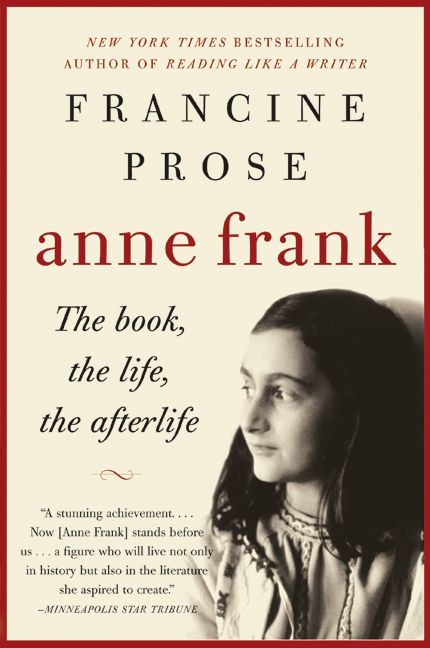 Book: ANNE FRANK, The Book, The Life, The Afterlife by Francine Prose (2009)
 Format: E-book
Owned Since: March 2015
E-books are not my preferred reading format. Batteries die, which is incredibly frustrating, and I hate reading on my phone. But I get at least two daily emails notifying me of cheap e-books, and at least once a week I click the "Buy" button. The Kindle app and the iBooks app are both loaded to both my iPad and my iPhone, and I'm afraid to tally up the number of unread books in my virtual libraries. They're all books I want to read, and I tell myself I'll get to them eventually.
Francine Prose's ANNE FRANK was one of those books. I'm glad I finally got to it. It should go without saying that no one should read this book without reading some edition of Anne Frank's diary first, whether that's THE DIARY OF A YOUNG GIRL, originally published in 1947 (but not in the US until 1952, for reasons Prose explains), or the revised/expanded DEFINITIVE EDITION published in 1995.
I first read the original diary when I was ten or eleven — that would have been fifth or seventh grade — and while it was on a couple of "suggested reading" lists for classes in high school and college, I never took a course that taught it. I've never seen the theatrical adaptation, by Frances Goodrich and Albert Hackett; and my own mother warned me off the 1959 film version, even though Shelley Winters won an Oscar for her portrayal of Mrs. Van Daan. I've reread THE DIARY several times over the years, and always felt a need to preserve that experience as mine, personally, without any outsiders telling me what to think of it or how to feel about it.
Francine Prose's book was an exception worth making. She gives us Anne Frank the teenager, Anne Frank the writer, Anne Frank the legend and ultimately Anne Frank the industry, walking us from Anne's own determination to be taken seriously as a writer through the wonderful and strange long-term effects her work has had around the world. Prose looks closely at the nature of memoir — as Anne's book ultimately was, since she rewrote the earlier entries herself over the last year of her life — and the difficulty of separating the writer from the work, even after the writer is gone.
Writing is a deeply personal act that creates something separate from the writer, something intended for strangers to read and react to. A writer can't always anticipate a reader's reaction, and certainly can't control it; and yet that writer-reader interaction is so intimate that the better the writer is, the more the reader feels he or she knows the author, and possibly someone the writer knows the reader as well. (See: Stephen King's MISERY.)
We can't know Anne Frank, but Prose shows us how the very action of writing her life down changed her. Measuring things, naming things, changes them; it's a fundamental law of the universe. Anne Frank would have changed more as she found new things to name and measure, and it's still a gaping wound in human history that she didn't get that opportunity.
One problem with reading is that it leads to more reading. A casual reference to Carson McCullers and her husband reminds me that I know almost nothing about Carson McCullers — I had not even known she was married — and makes me think I really ought to read something of hers beyond A Member of the Wedding, which I disliked when I had to read it in seventh grade. I also remember that Flannery O’Connor hated McCullers’ last book, which leads to the thought that I really need to reread The Habit of Being. If I read McCullers, which one should I read?
Tuesday, November 01, 2016
NaNoReadMo: 30 Books in 30 Days

At one point in my life, when I commuted by bus and Metro, I regularly read more than 200 books a year. Even after I started driving — and then even after I started working from home — I regularly read more than 150 books a year. Working at The (late, lamented) Mystery Bookstore boosted that number, but I've always been open-minded about where my books come from: bookstores, libraries, publishers, friends, Goodwill and yes, even Amazon.
Last year, for the first time in my adult life, my reading list didn't break 100 — and that was even after I let myself count everything I'd read for work, including galleys I proofread and manuscripts I edited. I topped out at 99, with an advance reading copy of the delightful BE FRANK WITH ME by Julia Claiborne Johnson. (Read it, it'll make you happy.)
This year my pace is even worse: I finished my 73rd book of the year, Thomas Mullen's DARKTOWN, yesterday, and again that list includes proofread galleys and edited manuscripts. If I keep reading at this rate, I won't even break 90 by the end of the year.
What happened to me? I got a smartphone. Apps now fill the waiting time I used to spend reading. Waiting for a bus? I'll check in with my virtual pals on Nats Twitter. Stuck on the Metro? Let's level up on Candy Crush. Train to New York? Somebody linked to a great article in The Atlantic . . . and am I caught up on the Wittertainment podcast?
I'm frittering my reading life away, and this year in particular the election news has become a malign drug. I know who I'm voting for. I know her adversary is a candidate of unprecedented venality and ignorance. I don't need to be any better informed about that person than I already am, and it's literally giving me nightmares.
So for the month of November, I'm changing course. I'm retreating into words on the page, and the goal is to read 30 books by the end of the month. That's a lot, but it's doable if I stay off social media and allow myself a few semi-cheats:
- Three of these books can be work-related (galleys I'm proofreading or manuscripts I'm editing)
- Three of these books can be re-reads
- A book longer than 500 pages counts as two books (I'm making this exception specifically for James Michener's TEXAS, which someone sent me as part of last month's book swap)
- Three of these books can be young-adult or children's books
Onward . . .
Thursday, September 22, 2016
On Letting Go
The art of losing
isn’t hard to master;
So many things seem
filled with the intent
to be lost that their
loss is no disaster.
It’s human nature to hang on. I’ve never been an accumulator of things, and I’m actively stupid about money, but that does not seem to make it any easier to let go. I made Dizzy, my dog, live too long in pain and confusion because I was too sad to let him go; delaying the sorrow didn’t make it any easier, and might have made it worse. I’ve stayed in jobs too long. I’ve lived in apartments too long. I’ve kept trying in relationships where it was obvious to everyone but me that I was wasting my time. I can look back on all these situations and see exactly where I should have walked away, but each new situation is just as hard as all the last ones were.
Last weekend I tagged along with friends to the House of Broel, a unique New Orleans structure that combines an events hall with a dollhouse museum and an exhibit of designer dresses, in a Garden District mansion that was built and expanded before The War. House tours are available by appointment only, and conducted by the home’s owner, Countess Bonnie Broel — the “Countess” is a legacy from her father, who fled Russia during the revolution.
Countess Broel is a small, glamorous, brisk woman of a certain age who distills everything that’s great about New Orleans, and possibly everything that’s great about Americans. She used to live in the House of Broel, and she used to run a couture business from its first floor. Her husband left her just before Katrina, and Katrina wiped out her business. She moved to the property’s carriage house, created a family foundation to preserve the home and its collections, wrote an autobiography and is now selling three of her dollhouses in order to protect the property after her death. She is energetic and gallant and shows no outward sign of mourning the three dollhouses for sale; she cares only that they bring in enough money to justify their loss.

The masterpiece of the dollhouse collection is a vast recreation of a Russian dacha that runs along one full wall of the second floor’s hallway, and stands at least ten feet high. The Countess said she had wanted to imagine what her father’s life had been like before he left Russia, and the result is a combination of Tolstoy and the Arabian nights, topped by an attic observatory with a tiny telescope and astrolabe.
The collection moved me, and the thought that the Countess is starting to sell it off moves me even more. The dollhouses represent so many possible lives, so many imaginary homes that are permanently luxurious and happy, never deserted and never torn apart by storms. But she seems content with her decision, satisfied with the thought of trading these precious creations for something that matters more to her.
This is what I focus on, what is directly relevant to me at this point in my life, as I too contemplate letting go of some things: what, if anything, am I trading those things for? As I let go, is it loss, or is it more like a trapeze I relinquish so I can grab on to the next one? Does letting go of one thing mean I get to keep something else, and if so, what might that be?
I don’t mean to be cryptic, only to find the universal in some specific questions we all eventually have to wrestle with. I’m grateful to Bonnie Broel and her collections for giving me a prism through which to consider them. And I wonder what my own dollhouses might look like.
Photo from the House of Broel Dollhouse Museum Gallery.
Sunday, September 11, 2016
On Homeland
It’s fifteen years today since the United States suffered its first coordinated attack on our continent. Fourteen years and eleven months since the United States invaded Afghanistan; fourteen years and ten months since Congress passed the USA PATRIOT Act; thirteen years and ten months since the creation of the Department of Homeland Security; thirteen years and six months since we started combat operations in Iraq; five years and four months since US forces killed Osama bin Laden.
My 13-year-old nephews and 10-year-old niece have never lived in a time when the United States was not at war. They have no memory of a time when you could drive past or even park in front of the White House. They have grown up in a world of metal detectors and “If you see something, say something.” See what has never been specified, nor has say what, nor has to whom.
In this new world, “what” is anything strange or other — and “strange or other” is proving itself to be the ultimate test of the American ideal.
Last month I had the opportunity to go to Belfast, and through the generosity of a friend took a Black Taxi tour of the political murals in the city’s Protestant and Catholic neighborhoods. A steel wall runs through the city, still, dividing Protestant and Catholic territory. Catholics are no longer prohibited from living on the Protestant side — but the murals, and the sectarian flags that fly on almost every lamppost, send the clear message: You are not welcome here.
As an American Catholic of Irish descent, I felt those flags as a warning.
I always knew, growing up white in the South, that the Confederate flag was offensive. But until I saw the green flag commemorating the centennial of the Battle of the Somme, and the white Ulster Banner, and the blue UFF flag, I did not understand that the Confederate flag is not just a symbol, but a message. That message is: this is our country, not yours. This is our history, not yours. You are a trespasser.
What could possibly be more un-American than that? The United States was founded as a nation whose citizens are bound not by ethnicity or any inherited attributes, not by religion, not by economic status, but by mutual commitment to shared ideals — those ideals being not only life, liberty, the pursuit of happiness, but the right of every citizen to participate in government, to own property, to move freely within the country, to speak without fear of government reprisal, and to expect equal justice under the law.
New American citizens swear to “support and defend the Constitution and laws of the United States of America against all enemies, foreign and domestic,” and to “bear true faith and allegiance to the same.” The very first amendment to the Constitution specifies that Congress “shall make no law respecting an establishment of religion, or prohibiting the free exercise thereof.” It is literally in the DNA of our nation.
With the few exceptions of entirely pure-blooded native Americans, all of us are descended from people who chose that American ideal and were lucky enough to find welcome here — or from people who were brought to this country without their consent, enslaved, and left to survive as best they could after liberation. To pretend that the descendants of willing immigrants and the descendants of enslaved people experience the United States in the same way is delusional — but we can still move together to embrace that ideal going forward, can’t we?
Regardless of how we got here, we’re all Americans now. And being American has nothing to do with your religion or your ethnicity or your socioeconomic standard, but with whether you agree on the fundamental rights of humanity as laid out by our Constitution.
This ideal has been a beacon to the world for 240 years. If we let it be chipped away because of the actions of 19 terrorists fifteen years ago, then they won after all.
My 13-year-old nephews and 10-year-old niece have never lived in a time when the United States was not at war. They have no memory of a time when you could drive past or even park in front of the White House. They have grown up in a world of metal detectors and “If you see something, say something.” See what has never been specified, nor has say what, nor has to whom.
In this new world, “what” is anything strange or other — and “strange or other” is proving itself to be the ultimate test of the American ideal.
Last month I had the opportunity to go to Belfast, and through the generosity of a friend took a Black Taxi tour of the political murals in the city’s Protestant and Catholic neighborhoods. A steel wall runs through the city, still, dividing Protestant and Catholic territory. Catholics are no longer prohibited from living on the Protestant side — but the murals, and the sectarian flags that fly on almost every lamppost, send the clear message: You are not welcome here.
As an American Catholic of Irish descent, I felt those flags as a warning.
I always knew, growing up white in the South, that the Confederate flag was offensive. But until I saw the green flag commemorating the centennial of the Battle of the Somme, and the white Ulster Banner, and the blue UFF flag, I did not understand that the Confederate flag is not just a symbol, but a message. That message is: this is our country, not yours. This is our history, not yours. You are a trespasser.
What could possibly be more un-American than that? The United States was founded as a nation whose citizens are bound not by ethnicity or any inherited attributes, not by religion, not by economic status, but by mutual commitment to shared ideals — those ideals being not only life, liberty, the pursuit of happiness, but the right of every citizen to participate in government, to own property, to move freely within the country, to speak without fear of government reprisal, and to expect equal justice under the law.
New American citizens swear to “support and defend the Constitution and laws of the United States of America against all enemies, foreign and domestic,” and to “bear true faith and allegiance to the same.” The very first amendment to the Constitution specifies that Congress “shall make no law respecting an establishment of religion, or prohibiting the free exercise thereof.” It is literally in the DNA of our nation.
With the few exceptions of entirely pure-blooded native Americans, all of us are descended from people who chose that American ideal and were lucky enough to find welcome here — or from people who were brought to this country without their consent, enslaved, and left to survive as best they could after liberation. To pretend that the descendants of willing immigrants and the descendants of enslaved people experience the United States in the same way is delusional — but we can still move together to embrace that ideal going forward, can’t we?
Regardless of how we got here, we’re all Americans now. And being American has nothing to do with your religion or your ethnicity or your socioeconomic standard, but with whether you agree on the fundamental rights of humanity as laid out by our Constitution.
This ideal has been a beacon to the world for 240 years. If we let it be chipped away because of the actions of 19 terrorists fifteen years ago, then they won after all.
Saturday, November 14, 2015
On Storytelling and Tragedy
 This morning, as the East Coast wakes up to realize last night's news from Paris was not just a terrible dream, I am thinking once again of W.H. Auden's poem about Bruegel's painting of Icarus, "Musée des Beaux Arts." I know I've written about this before.
About suffering they were never wrong,Today I have laundry to do. I have a ticket to Georgetown Basketball's home opener, and was planning to get there early enough to snag a Jack the Bulldog bobblehead. I have a ton of work to do before I flee the country next week: a newsletter to write for one client, a Wikipedia bio for another, four (!) manuscripts to be edited, and the usual social media stuff, which includes promoting a client's book event, happening tomorrow.
The old Masters: how well they understood
Its human position: how it takes place
While someone else is eating or opening a window or just walking dully along;
How, when the aged are reverently, passionately waiting
For the miraculous birth, there always must be
Children who did not specially want it to happen, skating
On a pond at the edge of the wood:
They never forgot
That even the dreadful martyrdom must run its course
Anyhow in a corner, some untidy spot
Where the dogs go on with their doggy life and the torturer's horse
Scratches its innocent behind on a tree.
In Breughel's Icarus, for instance: how everything turns away
Quite leisurely from the disaster; the ploughman may
Have heard the splash, the forsaken cry,
But for him it was not an important failure; the sun shone
As it had to on the white legs disappearing into the green
Water, and the expensive delicate ship that must have seen
Something amazing, a boy falling out of the sky,
Had somewhere to get to and sailed calmly on.
It all feels a little trivial, and yet that is exactly what it is not. Like Brueghel's ship, we have somewhere to get to, and sail calmly on. And the book stuff, especially, is not trivial, because storytelling in situations like this is what heals us and keeps us going.
In the days to come we will hear stories of kindness and heroism. These will be the stories we remember, the stories that survive. We repeat the stories that remind us of our best selves, we create the stories that describe the world as we wish it could be. Nothing, nothing is more important than that. We can be better than we are. The story does not end, as long as we keep telling it.
Tell someone that story today. Tell yourself.
Sunday, October 04, 2015
Social Media for Readers — The Basics

Before you get all indignant and worked up, I'll reassure you: I think it's wonderful that social media lets readers connect with authors. As a reader, I love being able to keep track of upcoming books and events via my favorite authors' Facebook pages and Twitter feeds. I know authors who have built hilarious, caring communities online, and when it all works well, it benefits everyone. I know lots of authors who have made personal, in-real-life friends among readers via social media.
As in any social setting, however, missteps are bound to occur. I'm willing to give the vast majority of people the benefit of the doubt, and assume that when people do say or do something inappropriate, it's not from malice, but because they don't know any better.
All of the following guidelines are based on the fact that social media interactions are public. Having someone you admire Tweet back at you, or reply to a comment on Facebook, can feel like getting a gold star —literally, because that's how you mark a Tweet as a "favorite." That feeling of being noticed, recognized, acknowledged and rewarded is what we're all on social media for. It's lovely, isn't it? There's nothing like it. But this interaction happens on a platform that is open to the entire world. It's not a kiss behind a closet door; it's a high-five on a football field. Therefore, rule #1 is this:
Do not make a comment, post a link or share a photo that the recipient would be uncomfortable receiving in a public place that includes his or her parents, spouse, children, employers and clients. Any public figure's social media account is his or her virtual office. Social media is a dangerous place for private jokes, even with the people you're closest to.
Do say hello, let the author know if you liked the latest book, ask about upcoming events, post photos taken at public events, ask questions about the book and the characters (respecting concerns about spoilers, below). Do understand that most authors have a full-time job other than writing, so maintaining social media networks might be something they have time for only after everything else — after they've gotten home from work, met their daily word count, had dinner with their families, put the kids to bed, etc., etc. Please be understanding if timely responses aren't always possible.
And a few corollaries:
- Spoilers. Personally, I don't care about spoilers. I was lucky enough to see both The Crying Game and The Sixth Sense before anyone told me the endings, and if someone out there still doesn't know that Keyser Soze is [REDACTED], I don't feel responsible for keeping them in the dark. But basic courtesies apply, especially in situations where a book's publishing date varies by countries. Social media is international. If you wouldn't have wanted to know before you read the book, don't mention it in a public electronic forum without marking it as a spoiler. How do you do that on Facebook or Twitter? Good question. You could try starting the post with the word SPOILER in large angry letters, then hitting a couple of returns before posting the meat of your comments. Or you could ask the page administrator to set up a private area for discussion; Facebook lets you do that. Or you could wait a year.
- Corrections. It happens to me, too: errors in spelling, punctuation, timelines, geography, word usage, etc. jump off the page and sometimes pull me out of the story. I hate when that happens. But it does happen, and in a book of 125,000 words, it might happen more than once. (And as I always say, most heart surgeons would be happy with a rate of two errors per 125,000 words.) If it really, really, really bothers you and you think it might bother other people too, it might be possible to correct the text for the paperback edition or the e-book. In that case, the polite thing to do is to send an email to the author via his or her website. Almost every author on Facebook will have a personal website that lets you do this. Better yet, send an email to the book's publisher. Leaving these corrections on someone's public Facebook wall, or Tweeting them in the public newsfeed, is the online equivalent of standing up in a cafeteria and announcing that someone has a mysterious stain on their trousers.
- Promoting your own book/services. It's rude to promote yourself on someone else's professional page or news feed, regardless of the circumstance. Don't do it.
- Demanding quid-pro-quo. Following someone on Twitter or Facebook does not obligate them to follow you back, or to like your page. If you're following people on Twitter or liking their pages solely in an attempt to get likes and follows for yourself, you're doing social media wrong. You might benefit from my earlier post.
- Harassment/Stalking/Trolling. Everybody on social media knows someone who's left a network because it became too unfriendly or scary a place. Some people, sad to say, actually enjoy that. If you're a troll, you know that you are, and this post isn't for you. You already believe the world's a rotten place, and you want the online community to be just as rotten. Know this, though: most of us disagree with you.
Sunday, July 12, 2015
Angels Unaware
 Yesterday, I stiffed Jesus. And I maybe, possibly, was the victim of a con artist. Both of these things may be true.
I had gone up to New York for a couple of days to see people who were in town for Thrillerfest, the annual gathering of the International Thriller Writers. It was a good time, but a lot of travel for a relatively quick visit. New York was hot and crowded and I have lost another small chunk of my field of vision, so just getting around the city is tenser than it used to be: I walk in front of people, I can't see people who are right in front of me (hi, Mark!), and that kind of concentrated socializing is exhausting when I'm used to spending days alone in front of a computer.
So when I got off the bus last night in Arlington, trudging into the Rosslyn Metro for the last leg home, I was tired and cranky and even a little bus-sick. A large woman about my age, dressed nicely with some dramatic eyeliner, was sitting with a cane right outside the Metro entrance.
"Excuse me," she said. "Do you live here? Are you from here?"
"Yes," I said.
"Can you talk to me for a minute?" she asked, so I stopped.
On the verge of tears, she told me a long and complicated story I had trouble following. She had gotten into a car accident that morning; she had gone to work, on a Saturday, at a Department of Commerce office in north Arlington. She had recently moved to this area from Atlanta, and was living with her mother in St. Charles, MD, a town so far from DC that I might not even call it an exurb. The bus to St. Charles wasn't running on the weekend, she said, and she was stranded. She needed $89 and change, an oddly specific number, to get a cab driver to take her home. She didn't have access to her bank account, which was in Atlanta. She had bone cancer, she said, which was why she had the cane.
I had a dollar in my wallet. I told her so. "There's an ATM right in there," she said. "I'll pay you back."
I remembered a time I had been stranded at an airport at the end of a trip, without enough money to get my car out of airport parking. My parents had bailed me out that time, and the manager of the airport hotel had let me eat at the breakfast buffet while I waited for the money to hit my account.
"I can give you $40," I said.
She walked with me to the ATM, and I took out $60 — that's what the ATM quick-withdrawal option dispenses, so I just hit that button. I gave it to her with my business card, and she said she'd pay me back. I wished her luck and went down the escalator to catch my own train. She had told me her name, but I can't remember it.
This morning, I wish I could. I wonder whether and how she got home. And I wonder why I didn't just give her $100. I could have. It's not money I can easily spare; a freelancer's life is a constant scramble, and this is the first year in 15 years of self-employment that I have any breathing room at all.
But, but, but. Jesus talked in parables, but on this question, he was absolutely clear. "For I was hungry and you gave me something to eat, I was thirsty and you gave me drink, I was a stranger and you invited me in . . . Truly I tell you, whatever you did for one of the least of these brothers and sisters of mine, you did for me."
It's actually none of my business whether this woman was truly in need, or a scam artist. She presented herself to me as someone in distress, someone in need. She asked me, personally, for help. It was in my power to help her and I did it halfway.
I don't feel great about this. I want to be the person who would rather get ripped off than turn her back on someone in trouble. I have tunnel vision in more ways than one, and I don't always see when the people closest to me need help and can't or won't ask. I'm going to be thinking about this encounter for a long time, and wondering what a whole-hearted response to that woman would have been.
Sunday, July 05, 2015
Because America (no, really)

A woman on the street told us the reading had been cancelled for security concerns. I hope that's not true, and I couldn't find anything in this morning's paper to confirm that. Nevertheless, the line to get into the National Archives wrapped around the building, so we worked our way over to the part of the Mall where the Folklife Festival would be starting in another hour or two.
 We had forgotten about the National Independence Day Parade, which was starting from 7th & Constitution at 11:45. It takes a while to get a parade that size organized, so we walked among floats and bands and people inflating giant balloons. The rain backed off, and everyone seemed happy to be there. The bands had come from all over the country — it's an honor but it's also hugely expensive, and I wondered how many bake sales, car washes, wrapping paper drives, etc. had gone into those appearances.
In our neverending political cycle, we hear angry people talk about "taking this country back." As I walked past a float sponsored by the Sikhs of America, I wondered, not for the first time: back from whom? Back to what?
The Sikhs were walking the Smokey the Bear balloon, and a Vietnamese-American group was walking the giant American eagle. One float carried clowns (Coulro-Americans?) and another carried cloggers. A Chinese-American group marched behind a man on horseback, dressed as the Lone Ranger. The Salvation Army Band led things off, and the Society for Krishna Consciousness followed about half a mile behind. I've never felt so American in my life, so joyful to be part of this nutty country where we are bound not by genetics or heritage or history, but by belief — belief in the self-evident truth that all are created equal, endowed by the Creator with the inalienable rights of life, liberty and the pursuit of happiness.

This country has never been about "back" to anything. The writers of the Declaration of Independence and the Constitution would have mocked the idea of "returning" to anything. They set out to create something entirely new, and they expected that it would continue to evolve as a government of the people, by the people, and for the people.
I empathize more than I want to with some of the people who talk about "taking the country back." Some of them have been friends of mine since high school or college. They did everything the way they were supposed to: they stepped up and took responsibility when they might not have wanted to, they went to school and applied for jobs and paid their taxes, and watched other people get chosen and promoted above them, including some they consider stupider, lazier and less qualified. Today's Republican Party offers them the fantasy of a time when they could reap the rewards of that struggle, but the ugly truth is that time never existed. The 1950s era of prosperity? Funded by the GI bill and VA housing loans, with a top income tax rate above 90%.
Growth and prosperity have always, always been driven by the people who bring something new to the party, who don’t do what they’re supposed to, who challenge received wisdom and are willing to take a risk. Some of those people were marching in yesterday's parade, and I was proud to be cheering them from the sidewalk.
Friday, June 12, 2015
(Almost) All My Controversial Opinions in One Place
I’m on social media a lot for both pleasure and work, and the temptation to speak my mind about things other people will disagree with sometimes gets overwhelming. Rather than post things 140 characters at a time, I’m putting them all up here to 1) get them off my chest and 2) make myself a
handy target for concentrated outrage so I can ignore it all in one place.
In no particular order, here goes:
The story of your life is about what you pay attention to. Pay attention to the people and things you love. Ignore the people and things you don’t. Fix what you can. Say yes as often as possible. Start every disagreement with the thought, “Could I be wrong here? And what are the consequences if I am?”
We should all live as our best selves, whatever we believe that to be. The overwhelming press coverage of Caitlyn Jenner’s transition makes me feel I’ve been trapped on an airplane next to someone who wants to tell me about her hysterectomy. It is none of my business. I didn’t ask, and I don’t want to know. Please let me get back to my book. Do you mind if I put my headphones on?
None of my business is a good way to get through life, except when you see someone in pain. Other people’s pain is everybody’s business. Other people’s joy is not, especially if it doesn’t interfere with your own.
Humor is based on shared assumptions, because it’s about surprise and inappropriate juxtapositions. When you ask, “Don’t you have a sense of humor?” you're really asking, “Don’t you share my assumptions about how the world’s supposed to work?”
We need to reinstitute mandatory national service: two years for everybody between high school and college, no exceptions except for profound disabilities. It doesn’t have to be military service alone. People could choose health care, infrastructure, education, community policing, sanitation. But we must have a system that brings people from disparate parts of our society together for a common goal, and shows people the work that goes into keeping it all running.
We need to have a national conversation about why we have police, and what we expect from our police forces. Some places probably need to disband their current police forces and rebuild them from scratch. Same goes for the prison system. No private citizen needs an assault weapon.
My personal pro-life credentials are pretty hard to challenge, but I don’t want to live in a society that enforces laws against abortion.
If you didn’t like a book, you didn’t like it. That’s fine. I don’t care for most seafood. That does not mean seafood is bad. I’m not going to go online and post one-star reviews of seafood restaurants — why would I do that? I’ll just go to a steakhouse instead. Bookstores work the same way.
Nothing is boring if you pay close enough attention. Boredom is exhaustion, depression or laziness.
We all start from a position of ignorance. It’s nothing to be ashamed of, but it’s nothing to be proud of, either. Until we admit our ignorance, we can’t learn what we need to know.
If Fox News or MSNBC is your only news source, you’re keeping your world very small. That can feel like a safe thing to do, but the bigger world and the broader conversations are happening without you.
If God is infinite, omniscient, omnipresent and omnipotent, our feeble human brains aren’t big enough to comprehend the true and complete nature of God. Sorry, we’re not. Every attempt is an approximation. I have my way, which is about feeling part of the community that produced me. You have a different way. God is big enough to welcome us all. If God can walk the earth as a living man — which I believe — God can also be a many-armed woman, or a bird-man made of gold. We can’t know. The whole point of faith is that it isn’t knowledge.
Most of what we can know comes down to ratios and patterns, things we identify as recurring. Color charts, musical scales, units of measurement.
Spelling counts. Vocabulary matters. The way we speak changes the way we think. We can feel things we have no words for, but we cannot know things we don’t have words or symbols for. Our names for things change the way we see them. The first time I heard my nephews say “firefighter” when I would have said “fireman,” I almost cried.
Because this is true, we need to be careful about the words we use for terrible things. Inconveniences and annoyances aren’t traumas, they’re part of life in the mosh pit. If you call a single unwelcome remark “harassment,” you are interfering with justice for the people who are truly harassed. Poison's in the dosage.
Last but not least, “I disagree” does not mean “You’re wrong.” Repeat that. “I disagree” does not mean “You’re wrong.” One more time: “I disagree” does not mean “You’re wrong.”
Thanks, I feel better now. Feel free to disagree in the comments, which will be moderated.
In no particular order, here goes:
The story of your life is about what you pay attention to. Pay attention to the people and things you love. Ignore the people and things you don’t. Fix what you can. Say yes as often as possible. Start every disagreement with the thought, “Could I be wrong here? And what are the consequences if I am?”
We should all live as our best selves, whatever we believe that to be. The overwhelming press coverage of Caitlyn Jenner’s transition makes me feel I’ve been trapped on an airplane next to someone who wants to tell me about her hysterectomy. It is none of my business. I didn’t ask, and I don’t want to know. Please let me get back to my book. Do you mind if I put my headphones on?
None of my business is a good way to get through life, except when you see someone in pain. Other people’s pain is everybody’s business. Other people’s joy is not, especially if it doesn’t interfere with your own.
Humor is based on shared assumptions, because it’s about surprise and inappropriate juxtapositions. When you ask, “Don’t you have a sense of humor?” you're really asking, “Don’t you share my assumptions about how the world’s supposed to work?”
We need to reinstitute mandatory national service: two years for everybody between high school and college, no exceptions except for profound disabilities. It doesn’t have to be military service alone. People could choose health care, infrastructure, education, community policing, sanitation. But we must have a system that brings people from disparate parts of our society together for a common goal, and shows people the work that goes into keeping it all running.
We need to have a national conversation about why we have police, and what we expect from our police forces. Some places probably need to disband their current police forces and rebuild them from scratch. Same goes for the prison system. No private citizen needs an assault weapon.
My personal pro-life credentials are pretty hard to challenge, but I don’t want to live in a society that enforces laws against abortion.
If you didn’t like a book, you didn’t like it. That’s fine. I don’t care for most seafood. That does not mean seafood is bad. I’m not going to go online and post one-star reviews of seafood restaurants — why would I do that? I’ll just go to a steakhouse instead. Bookstores work the same way.
Nothing is boring if you pay close enough attention. Boredom is exhaustion, depression or laziness.
We all start from a position of ignorance. It’s nothing to be ashamed of, but it’s nothing to be proud of, either. Until we admit our ignorance, we can’t learn what we need to know.
If Fox News or MSNBC is your only news source, you’re keeping your world very small. That can feel like a safe thing to do, but the bigger world and the broader conversations are happening without you.
If God is infinite, omniscient, omnipresent and omnipotent, our feeble human brains aren’t big enough to comprehend the true and complete nature of God. Sorry, we’re not. Every attempt is an approximation. I have my way, which is about feeling part of the community that produced me. You have a different way. God is big enough to welcome us all. If God can walk the earth as a living man — which I believe — God can also be a many-armed woman, or a bird-man made of gold. We can’t know. The whole point of faith is that it isn’t knowledge.
Most of what we can know comes down to ratios and patterns, things we identify as recurring. Color charts, musical scales, units of measurement.
Spelling counts. Vocabulary matters. The way we speak changes the way we think. We can feel things we have no words for, but we cannot know things we don’t have words or symbols for. Our names for things change the way we see them. The first time I heard my nephews say “firefighter” when I would have said “fireman,” I almost cried.
Because this is true, we need to be careful about the words we use for terrible things. Inconveniences and annoyances aren’t traumas, they’re part of life in the mosh pit. If you call a single unwelcome remark “harassment,” you are interfering with justice for the people who are truly harassed. Poison's in the dosage.
Last but not least, “I disagree” does not mean “You’re wrong.” Repeat that. “I disagree” does not mean “You’re wrong.” One more time: “I disagree” does not mean “You’re wrong.”
Thanks, I feel better now. Feel free to disagree in the comments, which will be moderated.
Sunday, February 01, 2015
Social Media for Authors - The Basics
It happened again this morning: I followed back an author who'd followed me on Twitter, and got a direct message asking me to "support indie authors" by buying this author's book. I immediately unfollowed and blocked this person.
Over the past couple of years, social media has become an important marketing tool for authors and publishers, and self-published authors in particular prize the various networks as free platforms for advertising and self-promotion. I help manage social media for more than one author, and I see how valuable it can be to build connections between author and reader, fuel word-of-mouth before and after new books come out, and create a public persona — a brand, even.
Social media is not, however, an electronic billboard, and using it that way is not only a waste of a great resource, it's actively counterproductive. Because human beings learn social skills by modeling the behavior of others, however, one author misusing social media leads to many authors misusing social media — and some seriously bad advice is out there for new authors, especially new self-published authors.
I'm giving away work I sell here, but this is important enough to me that I consider it a public service.
10 Tips for Authors on Social Media
1. Social media is social. Each social media platform creates communities of people who visit it for different reasons and use it in different ways. Choose your platforms first and foremost according to the ones you feel most comfortable with, then according to the ones that are most likely to be hospitable to your target audience. Twitter is an online cocktail party; Facebook is an online break room. Instagram is more like a flea market, and Pinterest is more like a crafts fair. Vine is the A/V club on spring break.
2. Social media is a long game. Sign up for an account and spend some meaningful time on it before you start posting things. Get a sense for what people talk about and how. No social media platform is the equivalent of a billboard or a TV ad; if you treat it that way, you'll be ignored and you deserve to be. In the beginning, at least, follow, like and friend accounts you find interesting, and don't pay any attention to whether or not they follow you back. Engage with them on what they're talking about or posting. If you treat it as a zero-sum game, you will always be losing.
3. Social media is about building a brand, not about selling a product. This is an offshoot of Tip #2. The most effective social media accounts are about the person, not about the product. They give followers a sense of who the person is: his or her interests, likes and dislikes. The goal is not to make followers say, "I want to buy this book," but to make followers say, "That person is so interesting, I want to know more, and I want him/her to do well."
4. Engage people on subjects of common interest — not your book. Replying to Tweets or leaving comments on Facebook, Instagram, Pinterest or Vine is just like entering any other kind of conversation. If someone interrupted your conversation to say, "Hey, buy my book," you would consider that person a clueless boor, and wonder who invited them to the party. Don't do it on social media.
5. Don't send strangers messages about your book. Following someone or friending them on Facebook is not an invitation to be sold to. Direct messages about your book or even public direct Tweets about your book are spam. Spam, spam, spam. They are spam and they are an abuse of the terms of use you agreed to when you opened your social media account.
6. Follow, like and friend people you admire, and people whose careers you aspire to. Watch how they use social media. Neil Gaiman, Anne Lamott, Mary Karr, Patton Oswalt, Rosanne Cash — these are just a few of the arts figures I follow who do Twitter really, really well. Go to your bookshelves, your iTunes playlist, your Netflix queue and find your favorites on your preferred social media platforms. Watch how they engage. Not everybody you admire will do it well, but enough will to give you some meaningful role models.
7. Don't schedule posts. Yeah, I know your online publishing forum has told you how great TweetDeck and all those other automated services are, and I've seen the blog advice on how to schedule automated daily and weekly Tweets. Don't do it, especially not on Twitter, where news breaks and where people go to get updates on the latest breaking tragedy. If the world is watching an earthquake on Twitter and your autotweets are promoting your latest erotic novel, you will become a laughingstock and you deserve to be.
8. Keep hashtags to a minimum, and keep them relevant. Overuse of hashtags marks you as an amateur, and on Twitter, at least, it's a waste of limited characters. And be real: reviewers and serious readers don't go on Twitter and search the hashtag #books.
9. Be who you are. You cannot create a false version of yourself on social media. I'm not talking about pen names or fictional characters, which can be quite useful to authors on social media. I'm talking about trying to disguise your essential self on a social media platform. It didn't work in middle school, and it won't work on Twitter. Let's say you write military thrillers, but you yourself are a research librarian; you cannot pretend to be an ex-Special Forces guy on social media. It's exhausting, it's unsustainable, and it will inevitably backfire on you. If you're just someone who really likes that world, be that person. Social media is a world of fans. Wear your fandom proudly, and don't pretend to be things you aren't.
10. Don't do it if you don't enjoy it. This is the single most important piece of advice I give my clients when they ask me about social media. If you're doing it because your publicist told you to do it, or because that self-publishing blog told you to do it, you're wasting your time and everyone else's. The most successful social media accounts are the ones run by people who are obviously having fun online, who engage wholeheartedly and like making those connections the Internet makes possible.
It is possible to make friends with strangers on social media, and you do that by discovering the interests and passions that connect you. One of these days, that interest or passion might be your own book — but you have to earn that. There are no shortcuts.
Over the past couple of years, social media has become an important marketing tool for authors and publishers, and self-published authors in particular prize the various networks as free platforms for advertising and self-promotion. I help manage social media for more than one author, and I see how valuable it can be to build connections between author and reader, fuel word-of-mouth before and after new books come out, and create a public persona — a brand, even.
Social media is not, however, an electronic billboard, and using it that way is not only a waste of a great resource, it's actively counterproductive. Because human beings learn social skills by modeling the behavior of others, however, one author misusing social media leads to many authors misusing social media — and some seriously bad advice is out there for new authors, especially new self-published authors.
I'm giving away work I sell here, but this is important enough to me that I consider it a public service.
10 Tips for Authors on Social Media
1. Social media is social. Each social media platform creates communities of people who visit it for different reasons and use it in different ways. Choose your platforms first and foremost according to the ones you feel most comfortable with, then according to the ones that are most likely to be hospitable to your target audience. Twitter is an online cocktail party; Facebook is an online break room. Instagram is more like a flea market, and Pinterest is more like a crafts fair. Vine is the A/V club on spring break.
2. Social media is a long game. Sign up for an account and spend some meaningful time on it before you start posting things. Get a sense for what people talk about and how. No social media platform is the equivalent of a billboard or a TV ad; if you treat it that way, you'll be ignored and you deserve to be. In the beginning, at least, follow, like and friend accounts you find interesting, and don't pay any attention to whether or not they follow you back. Engage with them on what they're talking about or posting. If you treat it as a zero-sum game, you will always be losing.
3. Social media is about building a brand, not about selling a product. This is an offshoot of Tip #2. The most effective social media accounts are about the person, not about the product. They give followers a sense of who the person is: his or her interests, likes and dislikes. The goal is not to make followers say, "I want to buy this book," but to make followers say, "That person is so interesting, I want to know more, and I want him/her to do well."
4. Engage people on subjects of common interest — not your book. Replying to Tweets or leaving comments on Facebook, Instagram, Pinterest or Vine is just like entering any other kind of conversation. If someone interrupted your conversation to say, "Hey, buy my book," you would consider that person a clueless boor, and wonder who invited them to the party. Don't do it on social media.
5. Don't send strangers messages about your book. Following someone or friending them on Facebook is not an invitation to be sold to. Direct messages about your book or even public direct Tweets about your book are spam. Spam, spam, spam. They are spam and they are an abuse of the terms of use you agreed to when you opened your social media account.
6. Follow, like and friend people you admire, and people whose careers you aspire to. Watch how they use social media. Neil Gaiman, Anne Lamott, Mary Karr, Patton Oswalt, Rosanne Cash — these are just a few of the arts figures I follow who do Twitter really, really well. Go to your bookshelves, your iTunes playlist, your Netflix queue and find your favorites on your preferred social media platforms. Watch how they engage. Not everybody you admire will do it well, but enough will to give you some meaningful role models.
7. Don't schedule posts. Yeah, I know your online publishing forum has told you how great TweetDeck and all those other automated services are, and I've seen the blog advice on how to schedule automated daily and weekly Tweets. Don't do it, especially not on Twitter, where news breaks and where people go to get updates on the latest breaking tragedy. If the world is watching an earthquake on Twitter and your autotweets are promoting your latest erotic novel, you will become a laughingstock and you deserve to be.
8. Keep hashtags to a minimum, and keep them relevant. Overuse of hashtags marks you as an amateur, and on Twitter, at least, it's a waste of limited characters. And be real: reviewers and serious readers don't go on Twitter and search the hashtag #books.
9. Be who you are. You cannot create a false version of yourself on social media. I'm not talking about pen names or fictional characters, which can be quite useful to authors on social media. I'm talking about trying to disguise your essential self on a social media platform. It didn't work in middle school, and it won't work on Twitter. Let's say you write military thrillers, but you yourself are a research librarian; you cannot pretend to be an ex-Special Forces guy on social media. It's exhausting, it's unsustainable, and it will inevitably backfire on you. If you're just someone who really likes that world, be that person. Social media is a world of fans. Wear your fandom proudly, and don't pretend to be things you aren't.
10. Don't do it if you don't enjoy it. This is the single most important piece of advice I give my clients when they ask me about social media. If you're doing it because your publicist told you to do it, or because that self-publishing blog told you to do it, you're wasting your time and everyone else's. The most successful social media accounts are the ones run by people who are obviously having fun online, who engage wholeheartedly and like making those connections the Internet makes possible.
It is possible to make friends with strangers on social media, and you do that by discovering the interests and passions that connect you. One of these days, that interest or passion might be your own book — but you have to earn that. There are no shortcuts.
Wednesday, December 31, 2014
Favorite Reads of 2014
I don't read as much as I used to. This morning I finished reading the manuscript of my friend and client John Connolly's next Charlie Parker novel, A SONG OF SHADOWS (coming to the UK in April 2015, in the US sometime in early summer), and that brought my total to 115 for the year. It is possible, but not likely, that I'll finish Lisa Unger's CRAZY LOVE YOU before the end of the day, but I wouldn't do that just to boost my number.
About half of my reading this year was work-related: manuscripts, review copies, books I read for conferences (I moderated two panels at this year's Bouchercon, which accounted for about a dozen books), and books I read in my capacity as a judge for the Willie Morris Award for Southern Fiction. One of my 2015 resolutions is to do more pleasure reading; too often this year, when I wasn't working, I was destroying my brain with a video game and calling it relaxation. It's true that books are competing not only with each other, but with Netflix and YouTube and Candy Crush, and I've been as guilty of that as anyone else.
In making my list of favorite reads of 2014, I've deliberately excluded my clients, even though they published great books this year, too: The Wolf in Winter by the aforementioned John Connolly, and Conquest by John Connolly and Jennifer Ridyard; Terminated by Ray Daniel; Suspicion by Joseph Finder; Desperate by Daniel Palmer; and Fatal Impressions by Reba White Williams. (All of these clients, by the way, have equally good books coming out next year — and so does Lisa Lutz, whose forthcoming How to Start a Fire may be my favorite among all the books I've ever worked on.)
Alphabetically by author, then, here goes:
Alison Gaylin, STAY WITH ME (2014). Stay With Me completes Gaylin's trilogy about Brenna Spector, a private investigator cursed with hypermnesia, an ability to remember everything that's ever happened to her in precise detail. Over the course of three books — and her entire career — Brenna's been trying to find out what happened to her teenaged sister, Clea, who disappeared when Brenna was only a child. That search has damaged every other relationship in Brenna's life, and is now threatening Brenna's connection with her own teenaged daughter, Maya. I was awed by how well Alison (who's a friend) brought this story to a heartbreaking, profoundly satisfying conclusion.
Donna Johnson, HOLY GHOST GIRL (2011). Donna's agent sent me this book, saying he thought it sounded like just my kind of thing, and he was right. Holy Ghost Girl is Donna's memoir of growing up in a tent revival community, as the daughter of a woman who became the organist for (and later mistress of) Brother David Terrell, an apocalyptic preacher. Donna remembers the practical details of that nomadic life in a way that reminded me how quickly almost anything can start to seem normal, if it's how you live every day; but what impressed me most was her extraordinary generosity of spirit toward the adults who raised her, even Brother Terrell. Brother Terrell is a weak, sinning man, but one who also seems to have access to a realm of the spirit most of us can't reach. These things are not mutually exclusive, Donna shows us, and having seen examples of that in my own life, I continue to ponder that mystery.
Stephen King, MR. MERCEDES (2014). You know what? Being popular doesn't mean that something's not good. I expect to see this book on next year's Edgars shortlist. Retired police detective Bill Hodges can't let go of his unsolved cases, especially the apparently deliberate mass murder of a crowd of people lined up for a job fair, run down by a man in a stolen Mercedes. When the murderer starts to taunt Hodges, the retired detective has a new series of clues to pursue, and a new lease on life. This book blew me away. As much as I admire Stephen King, I was surprised by what this book showed me about the genre I work in. I have already pre-ordered the sequel, FINDERS KEEPERS.
Frank Langella, DROPPED NAMES: Famous Men and Women as I Knew Them (2012). When I'm exhausted or burnt out on fiction, I read celebrity memoirs. I binged on them this spring, recovering from gallbladder surgery, and I have a stack I plan to go through this weekend. This one, a series of anecdotes — some very short, some longer — about the dead famous people Langella worked with, played with and slept with, is the literary equivalent of a whole can of Pringles. For the most part, he's kind, although some of the stories are sad, and a few have real barbs. I loved this book so much that when I finished reading it, I bought the audiobook so I could listen to Mr. Langella tell me the stories himself.
Laura Lippman, AFTER I'M GONE (2014). 2014 was an embarrassment of riches for me, as I got to read two full-length Laura Lippman novels —this one and the Tess Monaghan coming next year, HUSH, HUSH — as well as Laura's bibliomystery, "The Book Thing," and another e-book novella, "Five Fires." AFTER I'M GONE was my favorite of these, as well as being an objectively impressive book — a true ensemble story, about what happens to a family of women after the man of the house (husband, father) disappears. What appears to be the central mystery — what happened to Felix Brewer? — ultimately turns out to be irrelevant. The real story is, as the title suggests, about what happened after he left. Among other things to love about the book, the early chapters on Felix's courtship of his wife, Bambi, evoke memories of Herman Wouk's classic MARJORIE MORNINGSTAR, a favorite of both Laura's and mine.
Liza Palmer, NOWHERE BUT HOME (2013). This year's winner of the Willie Morris Award for Southern Fiction is a magical book about food, forgiveness and love, three topics that preoccupy me pretty much constantly. Aspiring chef Queenie Wake returns to her small Texas hometown and accepts a uniquely difficult job: preparing last meals for the death row inmates at the nearby state prison. Each meal becomes a meditation on Queenie's own past, including the alcoholic mother who taught her to cook and the high-school hero who was the love of Queenie's life. It's a beautiful, loving novel that feels like a gift and will make you want to eat chicken-fried steak.
George Pendle, STRANGE ANGEL: The Otherworldly Life of Rocket Scientist John Whiteside Parsons (2005). You know what they say about stepping on footnotes before they start to multiply? I discovered this book through a mention of John Whiteside Parsons in GOING CLEAR, Lawrence Wright's fantastic history of Scientology. Before he founded Scientology, L. Ron Hubbard spent some time in Pasadena, living in a group house of Aleister Crowley's disciples headed by John Whiteside Parsons, one of the founders of the Jet Propulsion Laboratory; in fact, Hubbard's second (bigamous) wife had been Parsons' sister-in-law/girlfriend. The story only takes a page or two in GOING CLEAR, but I had to know more. This wonderful, expansive biography by the author of THE REMARKABLE MILLARD FILLMORE (which I also recommend) deserves to be a movie — and is going to be, if all goes well. The Satanic bedhopping isn't even the best part of the book: the most fun are the stories of Parsons and his friends blowing things up in the San Gabriel mountains, and that turning out to be Science.
Louise Penny, A TRICK OF THE LIGHT (2012). I had spent a few years away from Penny's Three Pines series, after THE BRUTAL TELLING, which broke my heart, and its sequel BURY YOUR DEAD, which enraged me (and which I still consider a cheat, and which still makes me want to bite someone). This book, however, went a long way toward bringing me back into the fold. Artist Clara Morrow's professional triumph, a solo show at the Montréal Musée d'Art Contemporain, is ruined by the discovery of a dead body in her garden that night. The dead woman is a childhood friend of Clara's, and her death sets off a chain of events that shake Clara's world to its core. A TRICK OF THE LIGHT is not only a murder mystery but a brilliant story about women's lives, women's friendships, and how women discover their own value at midlife.
Alex Stone, FOOLING HOUDINI: Magicians, Mentalists, Math Geeks and the Hidden Powers of the Mind (2012). Probably my single favorite book of this year, this memoir of Alex Stone's life in magic becomes a discursive history of the art form. The thing about "magic" is that it often involves feats of skill, strength or technology that are just as amazing as the illusion the magician is offering; they're just complicated, and tedious, and hard to explain, and the audience would rather have the illusion. I like things complicated, and the obsessives who populate Stone's book are my kind of people. I'll reread this book in a month or two, and expect to get new things out of it then. If you're giving this book as a gift, pair it with Robertson Davies' Deptford Trilogy.
Joakim Zander, THE SWIMMER (2015). I got an early copy of this book through sources I cannot divulge, but the person who gave it to me said, "You know how everyone's supposed to be 'the new Le Carré?' This guy is the new Le Carré." I read this book in a single sitting. A veteran CIA operative abandoned his baby daughter decades ago; when, as an adult, she becomes an international target for reasons that seem unrelated to her parentage, her secret father does what he can to try to save her. The lines between hero and villain are fuzzy here, if they exist at all; as Steinbeck once said, there's no good and there's no bad, there's just stuff people do.
About half of my reading this year was work-related: manuscripts, review copies, books I read for conferences (I moderated two panels at this year's Bouchercon, which accounted for about a dozen books), and books I read in my capacity as a judge for the Willie Morris Award for Southern Fiction. One of my 2015 resolutions is to do more pleasure reading; too often this year, when I wasn't working, I was destroying my brain with a video game and calling it relaxation. It's true that books are competing not only with each other, but with Netflix and YouTube and Candy Crush, and I've been as guilty of that as anyone else.
In making my list of favorite reads of 2014, I've deliberately excluded my clients, even though they published great books this year, too: The Wolf in Winter by the aforementioned John Connolly, and Conquest by John Connolly and Jennifer Ridyard; Terminated by Ray Daniel; Suspicion by Joseph Finder; Desperate by Daniel Palmer; and Fatal Impressions by Reba White Williams. (All of these clients, by the way, have equally good books coming out next year — and so does Lisa Lutz, whose forthcoming How to Start a Fire may be my favorite among all the books I've ever worked on.)
Alphabetically by author, then, here goes:
Alison Gaylin, STAY WITH ME (2014). Stay With Me completes Gaylin's trilogy about Brenna Spector, a private investigator cursed with hypermnesia, an ability to remember everything that's ever happened to her in precise detail. Over the course of three books — and her entire career — Brenna's been trying to find out what happened to her teenaged sister, Clea, who disappeared when Brenna was only a child. That search has damaged every other relationship in Brenna's life, and is now threatening Brenna's connection with her own teenaged daughter, Maya. I was awed by how well Alison (who's a friend) brought this story to a heartbreaking, profoundly satisfying conclusion.
Donna Johnson, HOLY GHOST GIRL (2011). Donna's agent sent me this book, saying he thought it sounded like just my kind of thing, and he was right. Holy Ghost Girl is Donna's memoir of growing up in a tent revival community, as the daughter of a woman who became the organist for (and later mistress of) Brother David Terrell, an apocalyptic preacher. Donna remembers the practical details of that nomadic life in a way that reminded me how quickly almost anything can start to seem normal, if it's how you live every day; but what impressed me most was her extraordinary generosity of spirit toward the adults who raised her, even Brother Terrell. Brother Terrell is a weak, sinning man, but one who also seems to have access to a realm of the spirit most of us can't reach. These things are not mutually exclusive, Donna shows us, and having seen examples of that in my own life, I continue to ponder that mystery.
Stephen King, MR. MERCEDES (2014). You know what? Being popular doesn't mean that something's not good. I expect to see this book on next year's Edgars shortlist. Retired police detective Bill Hodges can't let go of his unsolved cases, especially the apparently deliberate mass murder of a crowd of people lined up for a job fair, run down by a man in a stolen Mercedes. When the murderer starts to taunt Hodges, the retired detective has a new series of clues to pursue, and a new lease on life. This book blew me away. As much as I admire Stephen King, I was surprised by what this book showed me about the genre I work in. I have already pre-ordered the sequel, FINDERS KEEPERS.
Frank Langella, DROPPED NAMES: Famous Men and Women as I Knew Them (2012). When I'm exhausted or burnt out on fiction, I read celebrity memoirs. I binged on them this spring, recovering from gallbladder surgery, and I have a stack I plan to go through this weekend. This one, a series of anecdotes — some very short, some longer — about the dead famous people Langella worked with, played with and slept with, is the literary equivalent of a whole can of Pringles. For the most part, he's kind, although some of the stories are sad, and a few have real barbs. I loved this book so much that when I finished reading it, I bought the audiobook so I could listen to Mr. Langella tell me the stories himself.
Laura Lippman, AFTER I'M GONE (2014). 2014 was an embarrassment of riches for me, as I got to read two full-length Laura Lippman novels —this one and the Tess Monaghan coming next year, HUSH, HUSH — as well as Laura's bibliomystery, "The Book Thing," and another e-book novella, "Five Fires." AFTER I'M GONE was my favorite of these, as well as being an objectively impressive book — a true ensemble story, about what happens to a family of women after the man of the house (husband, father) disappears. What appears to be the central mystery — what happened to Felix Brewer? — ultimately turns out to be irrelevant. The real story is, as the title suggests, about what happened after he left. Among other things to love about the book, the early chapters on Felix's courtship of his wife, Bambi, evoke memories of Herman Wouk's classic MARJORIE MORNINGSTAR, a favorite of both Laura's and mine.
Liza Palmer, NOWHERE BUT HOME (2013). This year's winner of the Willie Morris Award for Southern Fiction is a magical book about food, forgiveness and love, three topics that preoccupy me pretty much constantly. Aspiring chef Queenie Wake returns to her small Texas hometown and accepts a uniquely difficult job: preparing last meals for the death row inmates at the nearby state prison. Each meal becomes a meditation on Queenie's own past, including the alcoholic mother who taught her to cook and the high-school hero who was the love of Queenie's life. It's a beautiful, loving novel that feels like a gift and will make you want to eat chicken-fried steak.
George Pendle, STRANGE ANGEL: The Otherworldly Life of Rocket Scientist John Whiteside Parsons (2005). You know what they say about stepping on footnotes before they start to multiply? I discovered this book through a mention of John Whiteside Parsons in GOING CLEAR, Lawrence Wright's fantastic history of Scientology. Before he founded Scientology, L. Ron Hubbard spent some time in Pasadena, living in a group house of Aleister Crowley's disciples headed by John Whiteside Parsons, one of the founders of the Jet Propulsion Laboratory; in fact, Hubbard's second (bigamous) wife had been Parsons' sister-in-law/girlfriend. The story only takes a page or two in GOING CLEAR, but I had to know more. This wonderful, expansive biography by the author of THE REMARKABLE MILLARD FILLMORE (which I also recommend) deserves to be a movie — and is going to be, if all goes well. The Satanic bedhopping isn't even the best part of the book: the most fun are the stories of Parsons and his friends blowing things up in the San Gabriel mountains, and that turning out to be Science.
Louise Penny, A TRICK OF THE LIGHT (2012). I had spent a few years away from Penny's Three Pines series, after THE BRUTAL TELLING, which broke my heart, and its sequel BURY YOUR DEAD, which enraged me (and which I still consider a cheat, and which still makes me want to bite someone). This book, however, went a long way toward bringing me back into the fold. Artist Clara Morrow's professional triumph, a solo show at the Montréal Musée d'Art Contemporain, is ruined by the discovery of a dead body in her garden that night. The dead woman is a childhood friend of Clara's, and her death sets off a chain of events that shake Clara's world to its core. A TRICK OF THE LIGHT is not only a murder mystery but a brilliant story about women's lives, women's friendships, and how women discover their own value at midlife.
Alex Stone, FOOLING HOUDINI: Magicians, Mentalists, Math Geeks and the Hidden Powers of the Mind (2012). Probably my single favorite book of this year, this memoir of Alex Stone's life in magic becomes a discursive history of the art form. The thing about "magic" is that it often involves feats of skill, strength or technology that are just as amazing as the illusion the magician is offering; they're just complicated, and tedious, and hard to explain, and the audience would rather have the illusion. I like things complicated, and the obsessives who populate Stone's book are my kind of people. I'll reread this book in a month or two, and expect to get new things out of it then. If you're giving this book as a gift, pair it with Robertson Davies' Deptford Trilogy.
Joakim Zander, THE SWIMMER (2015). I got an early copy of this book through sources I cannot divulge, but the person who gave it to me said, "You know how everyone's supposed to be 'the new Le Carré?' This guy is the new Le Carré." I read this book in a single sitting. A veteran CIA operative abandoned his baby daughter decades ago; when, as an adult, she becomes an international target for reasons that seem unrelated to her parentage, her secret father does what he can to try to save her. The lines between hero and villain are fuzzy here, if they exist at all; as Steinbeck once said, there's no good and there's no bad, there's just stuff people do.
Monday, September 29, 2014
On having it coming
We all got it coming, kid.
—William Munny, Unforgiven
I can tell you exactly when and where: Sunday, January 22, 1984, in a service hallway in the Flour Mill apartment complex in Georgetown. I was a sophomore in college. One of that year’s leaders of Mask & Bauble, our theater group, was hosting a Super Bowl party. Washington’s team lost ignominiously to Oakland that year, 38-9, but I left before the game ended.
The person who hit me was someone I’d had a romantic relationship with, but at that point we hadn’t been dating for almost a year. He was seeing someone else, and so was I, but our breakup had been more than usually complicated, with some long-term repercussions. I was only 18; he was only a couple of years older. We’d been avoiding each other, but I’d gone to that party knowing it was likely I would see him, because I wanted to see him. Sometimes it works that way.
I don’t remember why or how we wound up alone in that hallway, but I’m sure it was because I wanted to talk to him, and he wanted to avoid a scene. I don’t remember what I said to him. What I remember is an open hand striking my cheek, and a small popping sound because my mouth had dropped open as I realized he really was going to hit me. Not hard — he didn’t knock out any teeth, he didn’t leave a mark. And I remember what I thought:
I guess I had that coming.Yesterday my friend Sue Lin and I had breakfast at a funky coffee house in downtown Baltimore, and she gestured to me as we sat down. “Do you see what that girl’s wearing?” she asked.

They left before we did. I suppressed the impulse to jump up and intercept her on the way to the door. What could I have said to her? What should I have asked? I’ve been thinking about it ever since.
If you haven’t seen the video of Ray Rice knocking his girlfriend out, don’t watch it. What it shows is Ray Rice and his fiancée having an argument before they get on the elevator, and it continuing once they’re in the elevator. She’s a slender woman; he’s an NFL running back. She flies at him, apparently scolding, and he cold-cocks her with a punch to the face. She goes down like a deflated balloon, and she is out. He drags her out of the elevator, then picks her up at the waist like a blow-up doll and drops her, still unconscious, immediately outside the elevator door while a hotel security manager looks on.
The Ravens have suspended Ray Rice indefinitely, but that wasn’t what happened first. What happened first was a press conference at which Janay Rice, having married the man who punched her, apologized for her role in the incident.
I guess I had that coming.Even now, I’m ashamed of my own behavior when I think of that January afternoon. To do that young man justice, years later I got a handwritten note from him, apologizing — for the slap, presumably, and for other things. I would like to say here, 30 years late, that I’m sorry for the damage I did him, too.
But.
But.
But.
Nobody has that coming. Nobody. Not in an elevator, not on a football field, not in a hockey rink, not on a playground. If you strike someone in anger, you are disqualified from further play. You leave the field. You apologize, you make amends, you get whatever help you need to learn more appropriate ways to manage your anger.
So I guess what I want to ask that girl I saw at Spoons yesterday — what I would ask her, if I ever see her again — is, “Do you think you have it coming? Do you?”
Thursday, September 18, 2014
On human nature, nationalism and self-determination

Above the auditorium entrance in Georgetown's Intercultural Center, which houses its School of Foreign Service, is a quotation from Pierre Teilhard de Chardin, Jesuit philosopher and paleontologist:
"The age of nations is past. It remains for us now, if we do not wish to perish, to set aside the ancient prejudices and build the earth."As a 16-year-old college freshman more than 30 years ago, I believed that. I wanted to do that. I saw that the division between our side and theirs was artificial and unsustainable, and I believed we were moving toward a new era of communication and peace.
This is why it's always young people who lead revolutions.
It's not cynical to say that human beings can't be trusted to do the right thing, it's history. The gift and curse of our creation is free will: we are capable of great goodness and great evil, but mostly we incline to indulgence and expedience. As an old boss of mine liked to say, we are pleasure-seeking and pain-avoiding. That's not a moral judgment, that's just biology. We breathe, we excrete, we eat, we reproduce. We fear darkness and danger, so we band together, and then we fight with each other because no group allows every member to get everything they want (Yeats on Ireland: "Great hatred, little room"). But because we are human and not rats, we yearn for meaning and we dream of freedom.
Teilhard wrote about nationalism in the wake of the Great War, where he had served as a stretcher-bearer at the first Battle of the Marne, and the battles of Champagne and Verdun. After the war, he got a doctorate in geology, and he spent most of the rest of his life doing paleontological fieldwork in China. What he learned and what he found gave him a mystical insight into the universality of the human condition, over both time and geography, and an understanding of the futility and wasted energy of national boundaries.
Because the first thing that nationalism does, Teilhard understood, is dictate who does and doesn't belong to a group. We are Us; you are Them. We celebrate Us, we reject Them, like that "Simpsons" episode about the old enmity between Springfield and Shelbyville. If you believe, as Teilhard did, as I do, in an omnipresent and all-forgiving God that created us all, there is no Them. Who would be Them? Who does God call "Them"?
Do away with nationalism, then, but it leaves us still with the drive to self-determination, which is not only a human desire but also, in this post-Eden exile, a human obligation. Especially now, in 2014, when our religions seem to be failing us and our governments and public institutions have become too large and complex to be held accountable in any meaningful way, we crave some sense of agency over our own lives. Or at least I do, which is why I have been self-employed for the past 15 years, and why I moved to a tiny town in the middle of nowhere, and why — or at least one reason why — I never married. It's not a noble thing; it's not so far removed from my three-year-old self, who snatched away utensils, washcloths, and items of clothing from adults with a shove and "By myself!" It's the teenager's manifesto: You're not gonna tell me what to do, man.
The problem with insisting on independence, I have found as I approach my sixth decade, is that people will give it to you. Cooperation and collaboration take time, energy, compassion and compromise. It is, in the short term, often harder to do something as a team than on one's own. It's just that teams can do more, for longer, without tapping out every one of their members.
My big lesson, after almost five decades on this planet, is that it's a lot harder to be a good team member than it is to be a solo operator. The mistake people make — or at least, the mistake I made, and continue to try to correct in myself — is thinking that belonging to a team means that the team comes first, and that the team's interests override its individual members'. The best teams balance the needs of the group with the needs of the individuals, and operate on a constant cycle of feedback: What do you need? What do we need? How are we doing? What are we doing? It's hard, and the bigger the group, the harder it gets.
So maybe Scotland has the right idea: take it down a notch. Make the group smaller, so that we all listen better. Can we get to a point where no country's big enough to marshal an arsenal that will destroy the world? That's probably naive. It's certainly romantic. But I watch today's election with fascination and hope. Whatever the outcome, it would be nice if it meant everyone listened to each other a little more closely.
Monday, September 01, 2014
Freelancing and the Law of Diminishing Returns

— Encyclopedia Brittanica
I could give you anything but time.
— Elvis Costello
It's Labor Day, and I'm working. I worked yesterday, too. I worked Saturday. This is the nature of things when you have clients instead of employers, and when your clients pay for prompt attention and rapid response. If I want to take time off, even a day, I have to let clients know in advance; I've learned this by making the mistake of not letting clients know in advance. A lot of what I do is not especially time-sensitive — does it make a difference, really, if you get manuscript edits back on Wednesday instead of Monday? — but some of it is, and some of the work I do is not the kind you can leave for 24 hours at a stretch without some kind of backup in place. I have no backup. That's also a common issue for freelancers.
I'd hoped to take a week off in July. I announced it to my clients well in advance. I had plans, or at least plans to do nothing, for at least five days and maybe as long as seven. But then one of my clients got an offer, and in turn made me an offer, neither of us could refuse. I figured I'd find a week to take off in August.
Instead, this August was the busiest I've ever had, in 15 years of freelancing. I turned work down in August. I'm still catching up. And I am exhausted.
A friend said to me yesterday that I work all the time, and it was meant as a personal criticism, not as a compliment. I admitted it. How could I deny it? I've gotten myself into a spiral I don't know how to break, though I see that it is unsustainable. I feel so anxious, all the time, about so many things I can't control. The only reliable remedy I've found for that anxiety is completing a task for a client, and the only sure motivator for me is an external deadline. So I keep the to-do list full, and I move from task to task, and I am so tired and distracted I put my phone in the dryer yesterday. (I heard it thunking before any damage was done.)
I need — I need — what do I need? It's more than a single day off, but I don't know what.
A Facebook meme is going around about the Ten Books that Have Stayed With You, and I posted my list last week after Erin Mitchell tagged me. One of the books I always include on that list is Gift from the Sea by Anne Morrow Lindbergh. My mother gave me a copy for Confirmation, and it ranks second (only behind John Connolly's The Book of Lost Things) as the book I've most often given other people. This morning I pulled it out again, and found this:
I want a singleness of eye, a purity of intention, a central core to my life that will enable me to carry out these obligations and activities as well as I can. I want, in fact — to borrow from the language of the saints — to live "in grace" as much of the time as possible.
If I could find that place, I tell myself, I would not need to be so busy. If I were not so busy, I tell myself, I could find that place.
I have no answers to this.
Subscribe to:
Posts (Atom)