Who's asking: Kris Dean, Mechanicsville, VA
Given human nature, we were probably having wars long before anyone figured out how to write about it. Written history dates back only to about 3100 B.C., when Sumerians and Egyptians separately started to keep records on stone or clay.
Thus, the first recorded war happened in that part of the world. It took place between Sumer and Elam, around 2700 B.C., and was fought in the area that is present-day Basra, Iraq. The first detailed military history records warfare between the Sumerian cities of Lagash and Umma, in 2525 B.C. Lagash won, and its king, Eannatum, commissioned a stone pillar (stele) to honor his victory.
Discussions of a lasting peace in the Middle East must begin with the awareness that this region has been at war for 5,000 years, more or less. In that context, it would be foolish to expect too much out of a two- or three-day summit meeting.
My Internet connection at home is down, for unknown reasons. I'm posting this from Freeport. If it takes me a day or two to respond to an e-mail, I apologize.
Five Random Songs
"Today I Sing the Blues," Aretha Franklin. From one of my all-time favorite albums, Aretha Sings the Blues (naturally).
"Red Red Wine," The Replacements. No, this is not a cover of the Neil Diamond song.
"Heaven," Talking Heads. Hey, we were just talking about this song! From Stop Making Sense, soundtrack to the best concert film ever.
"Sure Don't Feel Like Love," Paul Simon. I found this album, Surprise, a little hit-or-miss, but it's growing on me. This is a track I particularly like.
"Man of Peace," Bob Dylan. Very appropriate to today's question, although I don't want to believe what I once read about this song, which is that it's supposed to be about Anwar Sadat. Bob Dylan's a genius, but he's been wrong about some things.
Wednesday, January 24, 2007


Tuesday, January 23, 2007
How many people die waiting for organs every year?
Who's asking: Me
I couldn't find statistics for this on a world-wide basis, but the Department of Health and Human Services says that 17 Americans a day die waiting for a transplant that could save their lives.
On Sunday, one of those 17 people was Barbara Seranella, the author of No Human Involved and seven other novels featuring outlaw-turned-businesswoman Miranda "Munch" Mancini. Barbara's ninth book, a standalone called Deadman's Switch, is due out this April.
As awful and stupid as it sounds, Barbara was one of the lucky ones. She'd already had not one, but two liver transplants; her body rejected the first, and they managed to find a second one in time to save her life. When it became clear that this one wasn't working either, Barbara remained upbeat and active -- at Bouchercon in October, she was gray-faced but radiant.
I didn't know her well, only as bookseller/fan to author, but her visits to The Mystery Bookstore were always an event, even before she got sick. She was funny as hell, and she would say anything -- she had done so much and seen so much in her life that shocking the uptight was the last thing she worried about. And she was kind, kind in a no-nonsense way that sought no credit; many southern California writers can tell stories about the contacts she made for them or the advice she gave.
She was only 50 years old when she ran out of time on Sunday. The best tribute to her I can think of would be for everyone who reads this to go, right now, and print out an organ donor card here. Sign it and put it in your wallet, and tell your family you've done it.
One organ donor can help as many as 50 people. One of those 50 might write the next great American novel -- or direct another great movie, like heart-transplant recipient Robert Altman -- or just get to celebrate one more Christmas with her family.
It's not like any of us will need our organs in the next life.
Monday, January 22, 2007
Why is St. Monica a saint?
Who's asking: An anonymous Google searcher from somewhere in North America
St. Monica (333-387) was the mother of St. Augustine (354-430). Monica's husband, Patritius, drank and beat her until Monica's patience and prayers helped to change his nature, and won his conversion to Christianity. Monica's charity and faithfulness annoyed her son Augustine, but ultimately inspired him, and her constant prayers are credited with Augustine's conversion from Manichaeism to Catholicism. She was the one who introduced Augustine to St. Ambrose, who became Augustine's mentor and confessor. Monica is the patroness of the Archconfraternity of Christian Mothers, whose object is mutual prayer for straying sons and husbands.
Today we would call St. Monica co-dependent, and urge her to seek treatment; she would probably leave Patritius, wash her hands of Augustine, write a self-help book and host a talk show. I'm not sure this is progress.
The California city of Santa Monica is named because explorers found it on St. Monica's traditional feast day, May 4. Since Vatican II, the church has celebrated the feast of St. Monica on August 27, the day before the feast of St. Augustine.
Saturday, January 20, 2007
What do you have against adverbs?
Who's asking: Various clients
One of my clients, in fact, went so far as to say, "William Goldman uses adverbs. Are you saying he shouldn't?"
My answer to that was that William Goldman can do whatever he wants. He's William Goldman, and he rules.
The rest of us, however, should avoid adverbs when writing fiction. It's part of my larger rule, which most writing instructors call, "Show, don't tell." I find that advice useless, though what I say is probably just as vague: "Trust your reader."
Adverbs are bad because they do the readers' work for them, or compensate for lazy writing. Don't tell me that your character said something "teasingly;" I ought to be able to infer that teasing from the content of the dialogue. If I can't, the dialogue's not right. If someone's shrugging, you don't need to say that she shrugged helplessly or tiredly or carelessly or defensively; we should already know that from the action that preceded the shrug.
Likewise, modifying your adjectives is seldom a good idea. "Very," "extremely," "rather" and "quite" are weasel words, qualifiers that belong in political speeches and newspaper columns, not in fiction. Fiction ought to be the one place where characters say and do exactly what you intend them to say or do, without reservation or apology. (Unless that's the character.)
Do not write to me to defend your use of adverbs. Instead, examine your conscience and your prose, go your way and sin no more.
Friday, January 19, 2007
Where does space end and heaven begin?
Who's asking: Grace Lechner, Freeport, ME
Let's start with what we know. Space begins where the Earth's atmosphere ends. NASA gives astronaut status to anyone who flies more than 50 miles above the surface of the earth; some scientists say space begins at 400,000 feet (75.76 miles), where rockets start to experience the friction of the atmosphere when they come back to earth.
So where does space end? No one knows. NASA says that space may be finite or infinite, but in either case, nothing exists outside it.
We live in three dimensions, meaning that we have line and surface and direction. We can measure and describe what's around us, and that's what scientists do.
No one has ever been able to measure or describe heaven. Heaven is not on any map. Depending on what you believe, only one person has ever been to Heaven and come back, and Jesus didn't get terribly specific about what Heaven was like.
But people have always believed in some kind of heaven, which suggests strongly to me that such a thing exists (this is the ontological proof for God: if He didn't exist, we couldn't imagine Him). People have always imagined that Heaven looks like the place they've always wanted to be, whatever that is: warmth for people in cold climates, water for desert-dwellers, vast wealth for the poor.
My own theory is that Heaven is no place outside; Heaven is a secret locked in each of our hearts, and it's only when our hearts stop beating that Heaven takes over. I think that Heaven is not a place at all, but the best feeling we ever had, of trusting and being loved and going home.
Grace, who is five, probably doesn't remember where she was before she was born. None of us do, by the time we're old enough to put things into words. But if we were somewhere, maybe that's heaven.
What I Read This Week
Charlie Huston, Already Dead. Huston lays his own modern vampire mythology -- in the tradition of Matheson's I Am Legend -- on the structure of the classic hard-boiled PI novel. Very dark, graphically violent, extremely well-done.
Jess Walter, The Zero. The tag-line of this book is "A novel of September 12." It sat on my shelf for months, because I wasn't ready to put the events of September 11, 2001 into a story that would narrow its scope or reduce its significance. The Zero doesn't do that. New York police detective Brian Remy shoots himself in the head on September 12, but doesn't die; what follows is a surreal journey, as he agrees to work for an obscure government agency -- or maybe it's a private firm? -- and deals with his son's insistence that he's dead. None of it makes any sense; even at the end, you're not exactly sure what's happened. Which is exactly right. The Zero captures that lost, baffled, paranoid feeling of the autumn of 2001 better than I thought anyone could, and will go into a box of things to leave for my (hypothetical, very far in the future) grandchildren.
Charlie Huston, Caught Stealing. I'm interviewing Charlie next week for another Mystery Bookstore podcast, along with Megan Abbott and Theresa Schwegel; I've read both of Megan's books and both of Theresa's, so needed to catch up with Charlie's. (He's written five; I won't have time to read them all before next Saturday. Sorry.) Huston's first novel is the story of a very, very bad week in the life of Henry Thompson, failed baseball star-turned-bartender, who agrees to care for his neighbor's cat and winds up a murderer on the run. No redemption here, just survival -- that's not giving anything away, because Huston went on to write two more Henry Thompson novels (Six Bad Things and A Dangerous Man).
Thursday, January 18, 2007
Why do we put candles on birthday cakes?
Who's asking: Lilly Dean, Mechanicsville, VA
Lilly, 4, poses a question it had never even occurred to me to wonder about. Why do we set our birthday cakes on fire? What a very strange thing to do, when you think about it.
The origins of this custom go all the way back to ancient Greece, when worshipers at the temple of Artemis, the moon goddess, used to make offerings of cakes decorated with circles of candles; the ring of light represented the full moon. Hundreds of years later, Germans would put a single candle on a birthday cake, to represent the life spirit. Sometimes they would mark off the candles in segments, symbolizing the passage of the year. (Kathy and I had candles like this when we were little. They were marked off in years, and you were supposed to burn it down an inch once a year, on your birthday. Who knows what happened to those candles; they only went to 21, anyway, so they'd be long gone even if we'd kept up the tradition.)
Candles have always been part of religious rituals, and making a wish and blowing the candles out also has its roots in ancient pagan customs -- the idea is that the smoke carries your wish to heaven.
This morning's temperature of 0F was noticeably warmer than yesterday's -5F. You wouldn't think those five degrees would make much difference, but they do. Dizzy doesn't seem to mind it, as long as the sun is out.
Wednesday, January 17, 2007
How many grapes go into a single bottle of wine?
Who's asking: The quizmaster at The Liberal Cup, Hallowell, ME
According to the quizmaster -- and several websites I checked this morning, because I didn't believe this -- it takes 600 grapes to make an average bottle of wine. Any winemakers out there who can confirm or deny this? It seemed low to my pub trivia team; our guess was in the thousands (I won't embarrass us by saying how many thousands), because each grape doesn't give off much juice.
Yesterday was the first anniversary of my mother's death, so today is the end of the traditional "year and a day" of deep mourning. I've thought more than once in the past year that it's kind of a shame that we've abandoned the old mourning customs; back in the 19th century, when people wore black for a year and a day, everyone knew that those people would not be their usual bright shiny selves, and might not be working quite as well as everyone else.
Friends who've been through it told me last year, "It [grief] takes longer than you think it will," and that's the truth. Grief is like a lighthouse, it turns and flashes at intervals. Over time, the intervals get longer, but the beam's just as sharp when it hits. I miss Mom, and so do my sisters and brothers. We always will, and that's the way it's supposed to be.
At any rate, I wasn't terribly productive yesterday, and today promises to be not much better. I'm headed to Portland right now to see Richard Ford speak at the Portland Public Library, and plan to be back up to full speed tomorrow. (I'll still wear a lot of black, though. I always did, but not in a Morrissey kind of way.)
First Five Random Songs:
"(I Don't Want to Go to) Chelsea," Elvis Costello & the Attractions. The Strokes, the Arctic Monkeys, the Shins, none of those guys would exist if Elvis hadn't done it first.
"Maybe It's Imaginary," Kirsty MacColl. "I don't know much/But I'd like to know why." Exactly.
"You've Got to Hide Your Love Away," The Beatles. My favorite Beatles song. It's one of John's. We've discussed this.
"La La," Cortney Tidwell. This CD was a gift, I'd never have discovered her otherwise. She sounds a little like Kate Bush, a little like Bjork, a little like the girl from Sixpence None the Richer. It's a sound that grows on you.
"Whiskey Bottle," Uncle Tupelo. I once startled a friend by quoting this song -- it's one of my brother Ed's favorite lines: "Whiskey bottle over Jesus/Not forever, just for now."
Tuesday, January 16, 2007
Where did the name "United Kingdom" come from?
Who's asking: Jennifer Lechner, Freeport, ME
The song says, "There'll Always Be an England," and there pretty much always has been an England -- since the eighth century, at least, when Egbert of Wessex first unified Essex, Kent, Surrey and Sussex.
Since then England has been the Pac-Man of nations, gobbling up everything around it (Americans got the idea from somewhere). England and Wales were formally united in 1536; England became "Great Britain" with the annexation of Scotland, in 1707; and "the United Kingdom" formed in 1801, with the addition of Ireland.
The country's official name at that time was "The United Kingdom of Great Britain and Ireland." Since 1927, it's been "The United Kingdom of Great Britain and Northern Ireland."
The "Home Counties," a phrase that comes up frequently in historical British mysteries, are the counties closest to London: Hertfordshire, Essex, Kent, Surrey, Buckinghamshire, and (formerly) Berkshire and Middlesex. The designation comes from the old circuit Court of Assize, in which judges from London would travel around the Home Counties to hear cases during periodically-scheduled sessions. Now the phrase refers to the area considered commuting distance from London.
Monday, January 15, 2007
Was the Barbie doll based on a real person?
Who's asking: Richard Bostwick, Hallowell, ME
Before I get to this answer, let me state for the record that I have never owned a Barbie doll. Mom did not approve of them. My younger sisters, Peggy and Susan, had Barbies -- originally a gift from our dad, who I guess didn't get the memo -- but I never did, and as far as I know, my twin sister Kathy never did, either. To this day, I wonder whether having a Barbie would have made me a girlier girl, or whether I didn't insist on having a Barbie because I wasn't a girly girl. Too late now, in any case.
Anyway, according to Barbie's official biography, Mattel Toys' co-founder Ruth Handler invented the Barbie doll because her daughter, Barbara, had no three-dimensional dolls to play with that weren't baby dolls. Ruth and Elliott Handler introduced the Barbie doll at the American Toy Fair in 1959, and Barbie was among the first toys to have a nationwide television marketing campaign. The rest, as they say, is history.

But it's not the whole story. Before there was Barbie, there was a German doll named Lilli -- the same height as Barbie, the same blonde ponytail -- except that Lilli was the plastic representation of a Bild Zeitung cartoon character who... uh... traded one type of favor for another. In her book Forever Barbie: The Unauthorized Biography of a Real Doll, M.G. Lord describes the process of transforming Lilli -- originally designed to be a gag gift for men -- into something suitable for American pre-teens.
Now, of course, women spend a great deal of money trying to look like Barbie. If the original Barbie doll had been a real woman, her measurements would be 39-18-33; a few years back, Mattel reduced Barbie's bust size and made her waist a little bigger, but she's still not a realistic representation of a woman.
As the immortal line from Sid and Nancy goes, "I'll never look like Barbie. Barbie doesn't have bruises."
In other news, the first-ever Mystery Bookstore podcast is now live. I'm talking with Don Bruns, Jim Fusilli and Nathan Walpow about the stories and songs in their recent anthology from Poisoned Pen, A Merry Band of Murderers. To listen, go to iTunes, choose Podcast, click on "Advanced" from the toolbar menu, and then subscribe to http://www.mystery-bookstore.com/podcasts/rss.xml. Because this was the first one, there are a couple of technical glitches -- you can hear buzzing at a couple of points -- but we'll sort that out in future episodes.
Sunday, January 14, 2007
Photo of the week

It's snowing here, with total accumulation of up to six inches expected. My own winter began in earnest this morning, when I took my first fall on the ice. It was bound to happen... no real damage, but my best pair of black slacks may be permanently mud-grimed.
This photo's old, but I like it... Dizzy was waiting for Santa, or something.
Saturday, January 13, 2007
What is the difference between blue cheese and Gorgonzola?
Who's asking: An anonymous Google searcher from somewhere in North America
Mmm, blue cheese. Did you know that blue cheese provides the distinctive flavor of Cheetos® and other delicious puffed cheese snacks? Well, it does. (Which begs the next question: why, then, are cheese puffs orange and not blue-gray? Then again, would you eat a blue-gray snack food? Possibly not.)
Anyway, "blue cheese" is a descriptive phrase that encompasses dozens of different cow's, sheep's or goat's milk cheeses that are made with the Penicillium mold. (Next question: does blue cheese have antibiotic properties? I'm still researching this one, but Civil War surgeons did pack wounds with moldy bread.)
Gorgonzola is one of the oldest of the blue cheeses, dating back to at least the ninth century. Food historians say the distinctive blue mold on Gorgonzola developed accidentally around the 11th century, but was deliberately cultivated after that. (Gorgonzola was, at the time, a village near Milan; now it is part of the Milanese suburbs.)
Most blue cheeses are named after their places of origin: Maytag Blue comes from Iowa, Roquefort and Bleu de Bresse come from France, Stilton and Double Gloucester come from England, and so on.
One food website I found suggested having a blue-cheese tasting party, with port wine and burgundy as accompaniments. This sounds like a great idea to me... we're supposed to get an ice storm tomorrow night, so maybe I'll just stock up for a party of my own. You're welcome to stop by if you can get here.
Friday, January 12, 2007
If Macs are so great, why doesn't everyone have one?
Who's asking: Jennifer Lechner, Freeport, ME
At the end of my first week as a Mac user, I can only think of three reasons the entire country hasn't switched to Macs: ignorance, laziness and habit.
That's why I hadn't switched, anyway. Contrary to appearances, I am one of the most habit-bound, change-averse people I know. Big changes I can do; little changes make me so anxious they can paralyze me. (A couple of months ago, I switched toothpastes on a whim -- my new brand is Tom's of Maine, cinnamon/clove, and it rocks -- but for two weeks, I kept looking for the old tube of Colgate in my bathroom cabinet, and feeling panicky when I couldn't find it.)
But now that I have a Mac, after all that kicking and screaming, I can't believe it took me so long. In the words of my friend John Erath, I have drunk the Mac Kool-Aid. Every day I discover something new that it does, and it's all so easy it boggles my mind. I didn't have to load a printer driver on this machine; I just plugged in my old printer, and it worked. Same thing with the digital camera. It took me a few minutes to figure out how to store and move files around, but now that I have, that's easier than on PCs, too.
I'm still getting used to a couple of things. The "delete" key is just a backspace, and that annoys me. The aspect ratio of documents in Word is different than on my old machine -- but is the aspect ratio of a physical sheet of paper, so that makes more sense than the PC Word display.
But those are minor. I love the deck at the bottom of my screen, which shows all the programs available to me; the "e" for Entourage bounces adorably every time a new e-mail comes in. The picture quality on my screen is better than any PC I've ever had. The built-in speakers are quite good, though I might get some external ones (I've been warned: the urge to accessorize is the biggest danger of Mac ownership). This weekend I'll be launching the first in a series of podcast interviews for The Mystery Bookstore, and these will be entirely self-produced (by the store's computer guru and myself) on Mac software.
It's a whole new Mac world, and I like it. Join me, my friends! (Okay, that part where I said I wouldn't proselytize? Changed my mind.)
What I Read This Week
One of my New Year's resolutions was to make my way through the pile of paperback originals I've gotten from publishers over the last several months. In the last week or so, I've started four, and set them all aside at page 50. Shockingly, dismayingly bad, every one of them. This will be the subject of a longer post at a future date. In the meantime, I did finish...
Alexander McCall Smith, The Right Attitude to Rain. I needed something restful, but this was a little too restful. The third Isabel Dalhousie novel finds the Scottish philosopher wrestling with questions of love and loyalty, and ends with a surprise that -- I hope -- will liven things up a bit. Isabel's habit of questioning everything she does is charming at first, but distances the reader instead of making us feel closer to her. Frustrating, and I don't know whether I'll stick with this series.
Donna M. Lacey, Archie and Amelie: Love and Madness in the Gilded Age. John Armstrong "Archie" Chanler, an heir to the Astor fortune, married best-selling Southern novelist Amelie Rives in 1888. For the next seven years they drove each other crazy, as Amelie flirted with a serious of famous and infamous men and Archie pursued his dreams of building an industrial utopia at Roanoke Rapids, NC. Amelie was addicted to morphine; Archie believed he could channel supernatural wisdom through automatic writing, and that he could reshape his face to look like Napoleon's death mask. It ended badly, with Amelie marrying the artist Pierre Troubetskoy and Archie committed to Bloomingdale Asylum -- but the story is fascinating.
It's still National De-lurking Week, and only two people identified themselves yesterday... so if you're stopping by today, won't you please leave a comment to say hello in person? Thanks!
Thursday, January 11, 2007
Are elephants more closely related to pigs or to cows?
Who's asking: Patrick Miller, Jacksonville, FL
Actually, neither. While elephants, pigs and cows are all mammals, elephants belong to their own lonely order, Proboscidea, which includes elephants, mammoths, and several other species that are now extinct.
Biologists put animals together according to what they have in common, and at one time they thought that elephants' thick skin was similar to the skin of pigs, so the two species must be related. As they looked more closely, however, they saw that pigs and elephants don't really have that much in common. Now taxonomists believe that the two living sets of animals most closely related to the elephant are the hyrax and the sea cow ("sirenians" -- isn't that a great name? -- manatees and dugongs).
The idea that elephants might be related to manatees makes some sense. But hyraxes?


At first glance, one of these things is not like the others. But since 1945, taxonomists have placed the three types of animals in a superorder called Paenungulates, whose distinguishing feature has something to do with the amino acid sequences in their red blood cells.
I'm guessing they don't schedule many family reunions, though.
In other news, it has come to my attention that this is National Delurking Week in Blogworld. I've already done my part on another site, commenting on a forum I visit often but never post to -- and immediately getting into a snarky argument with a frequent poster. Sometimes it's best just to lurk... but today and tomorrow, if you visit here often and never comment, won't you just sign in and say who you are and where you're visiting from? I'll be fascinated. Thanks.
Wednesday, January 10, 2007
What happened to the "B" batteries?
Who's asking: Matthew and Henry Lavinder, Mechanicsville, VA
Have I mentioned that my three-year-old nephews are ridiculously bright children, and paragons in every way? Well, they are.
Santa Claus was extra good to them this year, and brought them a number of toys that require batteries. (This is something that seems to disappear in adulthood. The only batteries I ever buy any more are for my toothbrush and my remote controls. Why don't I have cool battery-operated toys? Wait, don't answer that.)
Anyway, the boys were shopping with their mother for C batteries, and Peggy went through the battery display with them: AA, AAA, AAAA, C, D, nine-volt. Where, the boys wanted to know, was B?
B batteries are no longer widely available because nothing uses them any more. Old radios used to operate on vacuum tubes that required two different batteries: an "A" battery to heat the vacuum tube, and a "B" battery that ran the rest of the radio. Improvements in technology did away with vacuum tubes in consumer electronics, which ended the need for the "A" and "B" batteries.
Before I forget, a very happy birthday today to Mr. Tod Goldberg, who may now officially be too old to be called wunderkind any more.
Five Random Songs
I skipped this last week because I had no access to my iTunes. The new MacBook has brought my iTunes back in all their glory. Hurray.
"You Will," Too Much Joy. Back in the late '90s, this was really sharp satire about telecommunications advertising campaigns. Now I have been faxed at the beach, and it doesn't feel so funny any more.
"The Busy Girl Buys Beauty," Billy Bragg. Ooh, it's Mock the Consumer Society morning on my iPod Shuffle! Did everyone read the New York Times article last week about how those fancy skin products do no good at all? My devotion to Oil of Olay has been vindicated.
"Come, Let Us Go Back to God," the Soul Stirrers. From The Ladykillers soundtrack, which I've raved about before.
"You Won't Have to Cry," The Byrds. No one sounds like them, even now.
"Yesterday," The Beatles. Some Beatles songs are so familiar that we don't really listen to them anymore -- and then one might catch us by surprise, as this one did, and we hear it as new and realize what geniuses these guys were. If you haven't listened to "Yesterday" or "Hey Jude" lately on headphones, by themselves and without distraction, I recommend that you do so, just to restore your sense of wonder.
Tuesday, January 09, 2007
How does skywriting work?
Who's asking: Carl Lavinder, Martinsville, VA
Any plane that leaves a condensation trail (contrail) can skywrite, theoretically. In practice, most skywriting is done by single-engine planes that force compressed vapor, mixed with a small amount of low-viscosity oil, through their exhaust system. Early pilots used a mixture of liquid paraffin; pilots today probably use something fancier.
Either way, skywriting doesn't last long. Each skywritten letter or figure is approximately a mile long and a mile wide, and winds scatter the vapor quickly. A letter or two at a time is all most single planes can manage, before the text blows away. To get around this problem, advertising pilots developed the technique of skytyping, which requires several planes working together to produce text, in a manner similar to a dot-matrix printer.
When I read this, the first question that popped into my mind was, "Well, how did the Wicked Witch write 'Surrender Dorothy' in The Wizard of Oz, then?" It turns out that that wasn't skywriting at all. Jack McMaster, the special-effects man for The Wizard of Oz, created the effect in a water tank, using dyed canned milk forced through a hypodermic needle (the witch's broom).
Sometimes I'd rather not know these things. Next, someone will probably write in and tell me the flying monkeys aren't real, either.
Monday, January 08, 2007
Does my cat know she's a cat?
Who's asking: John Schramm, Tracy, CA
John Schramm says he thought to ask this question when he showed one of his pets its reflection in a mirror; he says the cat looked at himself for a moment, then tried to clamber.
Believe it or not, scientists have done a lot of research into this question of whether animals are self-aware, and showing animals mirror images of themselves is one way they do it. So far, the only animals that seem to be able to recognize themselves in a mirror are humans, great apes (chimpanzees, gorillas, orangutans), dolphins, and elephants -- and even elephants can't do it, most of the time.
It's not even clear that what most animals see in a mirror looks like another animal to them. Cats and dogs see motion, more than anything else, and static images don't interest them. Dizzy adores Chris and Claire, for example, but doesn't pay any attention to photographs of them. He'd be much more interested in a tape recording of their voices, or in the smell of something they'd recently handled.
The deeper question here is whether cats and dogs have any idea of Catness or Dogness, and the answer is maybe. Cats, particularly, are predators, and predators divide the world into Prey and Predators, including things that might prey on them. Humans are neither, so cats seems to consider us either large and incompetent kittens (which is why they bring us their kills, since we're too feeble to be able to kill our own food) or intransigent tools.
Either way, it's rare for cat owners to say, "My cat thinks she's human," which is something you hear dog owners say all the time. In fact, this is backwards; a well-trained dog does not think it's human, it thinks humans are other dogs. Responsible dog training is based on the idea of adapting your dog's instinctive pack behavior to a pack of humans (or mixed humans and other animals). Dogs like order, and they want to know where they belong.
At the moment my own dog is damp and smelly, after a long walk in the pouring rain. He wanted to go, and I needed the exercise. At least it's not ice, which is what we were supposed to get this morning.
Saturday, January 06, 2007
Is all baby babble the same language?
Who's asking: Anna Bragdon, China, ME
I'm paraphrasing Anna's question. She noticed that her not-quite-five-month old, Wyatt, makes the same noises as a child of similar age born in the United States, although Wyatt spent his first four months (plus nine months in the womb) in Korea.
So is all baby talk the same language, the way (presumably) all dog talk is the same language?
Actually, no -- but yes, too.
Scientists know that babies hear and respond to speech even before they're born. They don't know the meanings of words, but they recognize recurring sounds and rhythms of speech, and from a very early age, they are more likely to pay attention to speech that follows the rhythm of their mother's.
That said, researchers at the University of Texas have identified four word patterns common to all babies, regardless of nationality. Babies make these noises because of the shape of the human mouth and jaw: "ma-ma," "da-da," "ba-ba," and "ta-ta."
This explains why the word for "mother" in almost every human language begins with or includes that "ma" sound. The word for "father" almost always includes the sounds "da," "ba," or "pa," which is very close to "ba." Following those sounds quickly are "na" and "ya."
In Korean, the word for "mommy" is "umma" (UM-ma) and the word for "daddy" is "oppa" (OP-pah). So whether Wyatt is trying to say "umma," or "mama," he's making the same sounds.
Friday, January 05, 2007
What I Read This Week
Crashing on a deadline today and out of questions to answer, so this will be short. (Send me some questions, folks -- leave them in the comments section, or e-mail me at LambLetters -at- gmail.com.)
Dan Simmons, The Terror. An epic horror novel about the doomed Sir John Franklin expedition to find the Northwest Passage, 1846-1849. It's not enough that they're frozen into the ice and darkness, with no means of communicating with the rest of the world and a rapidly-spoiling food supply; the men are being hunted by a monster who makes the ice its home. The only one who seems safe is the mysterious native woman Lady Silence, whose tongue is missing -- not cut off, but chewed. Fascinating, plausible, truly scary, a little long.
Jesse Kellerman, Trouble. Medical student Jonah Stem becomes a fifteen-minute hero when he saves a young woman from being killed on the street. But the NYPD wants to talk to him about the incident -- which left the woman's assailant dead -- the dead man's family is suing him, and the extra attention is just making his life harder. Then the woman herself shows up in Jonah's apartment, and his life is turned completely upside down. Trouble is a terrific, perceptive, paranoid thriller; I read it in a single sitting, which almost never happens any more.
Thursday, January 04, 2007
What happens when you flip your rearview mirror and how does it work to cut the glare?
Who's asking: Tod Goldberg, La Quinta, CA
Did you ever notice that your car's rear-view mirror isn't just a flat piece of glass, but a whole capsule with glass at the front? The glass you see at the front of the rear-view mirror is just that -- clear glass, not really a mirror. The mirror is behind the glass you see, and when you flip the rearview mirror up or down, you adjust the angle of the reflecting surface behind the glass.
If I knew how to draw online, I could show this more easily than words can express it. When the rear-view mirror is in its daytime position, the image of whatever's behind your car bounces directly off the reflecting surface at the back of your rear-view mirror, into your field of vision. When you flip the switch, the reflecting surface tilts so that it's looking at your car's ceiling. Light comes in your back window and passes through the front glass of the rearview mirror, bouncing off the angled reflecting surface at the back of the mirror and then back into your eye -- so the headlights you "see" in the mirror are actually reflections of a reflection, and much dimmer than if you were getting a head-on view or a single reflection.
Aren't optics cool? One of my favorite places in Santa Monica is the Camera Obscura in Palisades Park -- it is open to the public and free, just a big dark room where you can see the outside world reflected on a circular white table in the center of the room.
This is my very first post as a brand-new Mac user -- yes, it's happened, and I am now the proud owner of a gorgeous new MacBook. I feel a little like a newly-shaven Hare Krishna. I promise not to proselytize.
Wednesday, January 03, 2007
Is it true that albino moose were seen in Greenville, Maine?
Who's asking: Richard Bostwick, Hallowell, ME
A photo's been circulating online of two albino moose, with an attached e-mail saying the photographer had seen the two near Greenville, which is a good bit north of here, on the southern tip of Moosehead Lake.
I can't confirm or debunk the existence of these particular moose -- one Maine wildlife website I visited said the same photo had been circulating about a year ago, and that the moose were actually in Canada.
But it's possible. Albinism occurs in 1 in 100,000 moose, and more often than that when herds with the trait inbreed, as seems to have happened in southeastern Idaho. The Maine Department of Inland Fisheries and Wildlife estimates Maine's current moose population at 29,000, so that means the chances of seeing one albino moose, much less two, are awfully low.
I still haven't seen a live moose, and it's on my list of Things to Do in 2007. You can read all about them on the Fish & Wildlife site here.
Tuesday, January 02, 2007
Are you back online?
Who's asking: Various people
Sort of. Because my computer is still under warranty, it will have to go back to the factory for assessment and repairs. It seems likely that the motherboard was blown, so I've retrieved what I needed from the hard drive and will be renting a new machine tomorrow. In the meantime, the Bragdons have kindly lent me an ancient laptop that has Microsoft Word and a dial-up modem, so I'm getting by. I'm posting this from the Gardiner Public Library, and long may it prosper.
Life and baseball are all about streaks and slumps, and I'd be lying if I didn't say I believe I'm slumping at the moment. The only remedy is to keep swinging, and wait for the streak to come back around.
Happy new year, everybody.
Saturday, December 30, 2006
What are you doing New Year's Eve?
Who's asking: Johnny Mathis
Okay, so he's not asking me personally. Nevertheless, my answer is: As little as possible, unless Mr. Mathis wants to send a private jet for me.
Back in Gardiner after a 12-hour drive yesterday -- not too bad, except for a multi-car accident on I-84 that made the endless drive through Connecticut even longer. Dizzy was a trouper.
I'm posting this from the Gardiner Public Library, because it turns out that Capitol Computers is closed on Saturdays. Getting there this morning was the point of driving back yesterday... the moral of that story is, always call first.
Still, I'm glad to be home again. I've been unusually burdensome on friends and family over this holiday season, and I apologize -- and say thank you, never enough, for putting up with me.
Unless I can borrow a computer from one of my long-suffering friends, I'm offline until Tuesday. Happy new year.
Friday, December 29, 2006
What is a good answer to a girl who asks, "Why do you love me?"
Who's asking: An anonymous searcher from North America who reached this blog by putting this question on Ask.com
First of all, I have to say how discouraged I am by the fact that the vast majority of people who've landed here through search engines lately have been looking for photos of Britney Spears and Paris Hilton without their underwear. Get over it, people; you have my sorrow and my pity.
Today's questioner has my curiosity. Why does he love this unknown girl? Why does he need a computer program to help him explain his feelings?
The only correct, truthful and safe answer to this question is, "I just do." If you want to elaborate, you can say, "You fill me with wonder, and I'm happy in your presence. Doing something with you automatically makes it more fun and more interesting."
It's okay to describe attributes about this girl that you consider especially lovable, but be very careful about this. Do not say that you love her because she's beautiful, or because she's hot; one day she might not be beautiful anymore, and will you still love her then? The last thing you want is a conversation that continues, "Would you still love me if..." That can only end badly.
If this seems vague and unsatisfactory, think about it from the opposite side. What would you say to someone who asked, "Why don't you love me?" You wouldn't even think about answering that question, except to say, "I just don't. I'm sorry."
Because love, in the end, doesn't need a reason. That's the point of it.
What I Read These Weeks (special two-week edition)
Michael Crichton, Next. Not a novel, as much as a series of fictional case histories that illustrate the potential dangers of commercially-exploited genetic research. Interesting for the scientific information, but tedious as fiction.
Evelyn Waugh, Vile Bodies. Kevin Wignall recommended this as one of the best things he'd read this year, so I finally picked it up. It's a bitterly funny novel about the Bright Young Things of the late 1930s, who believe in nothing but can't help hoping for something real. I should have read Decline and Fall first, and now have to go back to place the book in its proper context.
Christopher Moore, You Suck: A Love Story. Moore wrote this book for fans who'd been begging for a sequel to Bloodsucking Fiends, his San Francisco vampire comedy. New vampires Tommy and Jody must figure out how to feed themselves while on the run from a couple of homicide detectives, Tommy's former supermarket co-workers, and a blue Las Vegas call girl who's decided that she'd like to be a vampire, too. They recruit a Goth teenager to help them, and Abby Normal (that's what she calls herself) is a most welcome addition to Moore's fictional universe. The book's ending demands another sequel, so AuthorGuy, we're already waiting -- even though You Suck isn't on bookstore shelves for another week or two.
Jeannette Walls, The Glass Castle. This memoir of a seriously dysfunctional childhood was fascinating while I read it; Walls' alcoholic father and apparently borderline mother took their four children all over the country, on the run from creditors and looking for the next big opportunity. It's remarkable that Walls and her siblings managed to survive and triumph over their childhood of neglect and near-starvation, but I finished this book with the flat, slightly queasy sense of voyeurism I often get from memoirs.
Dizzy and I are headed back to Maine today. First stop tomorrow morning is Capitol Computers, to see what they can do about my laptop. Unless they can give me a loaner, I may be offline altogether until Tuesday. If you need to reach me, do it the old-fashioned way.
Thursday, December 28, 2006
Should President Ford have pardoned Richard Nixon?
Who's asking: Ashton LeBourgeois, Washington, DC
Yes.
Gerald Ford packed an extraordinary amount of history into a term of fewer than 1,000 days. In the wake of Watergate, he navigated the country out of Vietnam, created an amnesty program for draft dodgers, laid the foundation for rescuing the nation from the worst economic slump in 40 years, appointed the first woman Cabinet Secretary since the 1940s, and maintained the uneasy balance of the Cold War even as we showed ourselves to be weaker than we'd claimed.
None of those things would have been possible if the nation had been focused on the trial and conviction of our former President. The rest of the world would have seen a nation humiliated and in chaos; our own citizens' heartsickness would have festered; and the worst partisan divides would have become irreparable. We'd have risked anarchy.
Knowing it would be an unpopular decision, Gerald Ford did what he thought was best for the country, and I think history has justified him.
In asking this question, Ashton said it was the "wrong decision for the right reasons," and argued that Richard Nixon should have been held accountable for his crimes, just to prove that we are a country of laws rather than men. It was fundamentally unfair, Ashton said, that Nixon escaped legal retribution.
It's hard to disagree with that, but Nixon's eventual conviction was no sure thing. Conspiracy is one of the hardest of all crimes to prove, and Nixon was careful. If the nation had endured a year-long trial that ended in acquittal, what would have happened then?
No, Gerald Ford made the right decision. I saw an article yesterday that quoted Henry Kissinger as saying that modern politicians want to be stars; Gerald Ford wanted to be a hero. In the end, he was.
Wednesday, December 27, 2006
We interrupt this blog...
To report yet another computer-related emergency. A drink got dumped into my keyboard last night (accidentally, and not by me), and the computer is no longer working at all. I'm posting this on a borrowed Apple laptop, and taking my own machine somewhere this morning to see whether anything can be done for it. If I am slow in responding to e-mails, or miss a few days on the blog, this is why. Sorry.
The moral of this story is to be careful about what you ask Santa for. I asked Santa for a vacation, and I suspect that this is his way of forcing one on me. Nevertheless, when I said "vacation," I meant some place with sandy beaches and green lawns and drinks at poolside. I have a large manuscript and three research books I can work on today without needing a computer. So there, fat man.
All the same, I might go to the movies this afternoon.
This morning's news about President Ford is not a surprise, but it's sad all the same. One of my projects this year confirmed my childhood impression: he was an honest and honorable man asked to do an impossible job, and he never got the gratitude he deserved.
Instead of five random songs today, here are my five favorite CDs of 2006. I don't buy a lot of new music, and don't pretend to have my finger on the pulse of the music world -- I just liked these a lot.
Roseanne Cash, Black Cadillac. This CD came out the week Mom died, and Jen Lechner gave me a copy that I have been listening to ever since. Words can't express how much I love this album.
Belle & Sebastian, The Life Pursuit. Fine, call them precious. Call them twee. I love this record, folk-pop for smart people.
The Pernice Brothers, Live a Little. Joe Pernice combines tragic lyrics and happy tunes better than almost anyone.
Madeline Peyroux, Half the Perfect World. She sounds like Billie Holiday; she sounds like Diana Krall; she sounds like no one but herself. Her covers of "River" and "Smile" are brilliant, and she makes "The Heart of Saturday Night" her own.
Scissor Sisters, Ta-Dah. Nothing but a good time, the perfect record to brighten a gloomy day.
Tuesday, December 26, 2006
Where are the seeds on a pineapple?
Who's asking: Henry Lavinder, Mechanicsville, VA
Henry was eating a tangerine the other morning and complaining about the number of seeds in it. We discussed the fact that tangerines grow, and that every plant that grows has seeds.
The next morning he said, out of nowhere, "Pineapples grow."
"That's right," I said.
"But pineapples don't have seeds," he said. I'm not sure how he knows this; we weren't eating pineapple at the time, and Peggy says they don't eat a lot of pineapple.
"You're right," I said. "I will investigate."
It turns out that pineapples do have seeds, but they appear on the flowers, which we never see. It's hard to grow a pineapple from seeds; farmers usually sprout new plants from slips and suckers, and sprouting a plant from a pineapple crown is a time-honored elementary school science project.
Pineapples themselves are not a single fruit. Botanically, each pineapple is a cluster of fruits that grow and merge together around the fibrous core, which is actually a stem/stalk.
The pineapple is the American colonial symbol of hospitality, because they were so rare and expensive that a host who put out a pineapple for his guests was really giving them his best. Yesterday's Christmas celebration at the Lavinders upheld all standards of Southern hospitality, and it was a wonderful day. Pictures are on their blog, here.
Dizzy and I start the journey north this afternoon, and will make it as far as Washington, D.C. tonight.
Sunday, December 24, 2006
What do you want for Christmas?
Who's asking: Santa Claus, North Pole
Same things I want every day.

Wishing you all the beverages and redemption of your choice, on Christmas Day and throughout the year.
Same things I want every day.

Wishing you all the beverages and redemption of your choice, on Christmas Day and throughout the year.
Saturday, December 23, 2006
What are the words to the joke version of "Jingle Bells"?
Who's asking: Therese Schulz, Herrsching, Germany
Some traditions need to be preserved and shared across cultures.
No, it doesn't make any sense. But neither does "one-horse open sleigh," in today's environment.
The other silly carol that always comes to mind at this time of year is:
What other wacky carol lyrics do you remember? Post them in the comments section below, and pass me that eggnog...
Some traditions need to be preserved and shared across cultures.
Jingle bells, Batman smells,
Robin laid an egg
Batmobile lost its wheel
And Joker got away!
No, it doesn't make any sense. But neither does "one-horse open sleigh," in today's environment.
The other silly carol that always comes to mind at this time of year is:
We three kings of Orient are
Tried to smoke a rubber cigar
It was loaded, it exploded
Now we're on yonder star...
What other wacky carol lyrics do you remember? Post them in the comments section below, and pass me that eggnog...
Friday, December 22, 2006
What's your favorite Beatles song?
Who's asking: John Schramm, California
This is like asking for my favorite flavor of ice cream -- why do I have to choose just one? (If I do, it's fudge ripple. But sometimes strawberry. And rum raisin is good, too.)
So if I had to pick only one, it would be "You've Got to Hide Your Love Away," a George Harrison composition on Help. It combines all the tuneful cheer of classic Beatles pop with heartwrenching adolescent angst ("Gather round, all you clowns/Let me hear you say/'Hey, you've got to hide your love away'"). Favorite Lennon/McCartney composition: "A Day in the Life," a whole life in one song. Favorite Beatles album: Revolver, which was every bit as revolutionary as Sgt. Pepper.
What's your favorite? Leave it below.
Best Things I Read in 2006 (Part Two):
Robert Greenfield, Timothy Leary: A Biography. Greenfield accomplishes the near-impossible here, making a compelling book from the life of a genuinely rotten human being. Essential cultural history.
Robert Littell, Legends. Retired spy Martin Odum can no longer remember which of his undercover identities is the "real one." Legends digs deep into the question of identity, and was so gripping I lost a night's sleep over it.
Christopher Moore, A Dirty Job. The right book at the right time for me; the story of beta male Charlie Asher, who finds himself an instrument of doom in the wake of his own wife's death. Hilarious, sad and deeply compassionate.
Mary Roach, Spook: Science Tackles the Afterlife. Another book I read at exactly the right time. Roach follows her fascinating Stiff: The Curious Life of Human Cadavers with this look at scientific research into heaven, reincarnation, spiritualism and more. Spook manages to be both respectful and funny, and left me feeling optimistic.
Anne Tyler, The Amateur Marriage. Anne Tyler is our generation's Edith Wharton. She covers most of the 20th century in this story of Michael and Pauline's troubled marriage. This is the book that I wanted Alice McDermott's After This to be.
This is like asking for my favorite flavor of ice cream -- why do I have to choose just one? (If I do, it's fudge ripple. But sometimes strawberry. And rum raisin is good, too.)
So if I had to pick only one, it would be "You've Got to Hide Your Love Away," a George Harrison composition on Help. It combines all the tuneful cheer of classic Beatles pop with heartwrenching adolescent angst ("Gather round, all you clowns/Let me hear you say/'Hey, you've got to hide your love away'"). Favorite Lennon/McCartney composition: "A Day in the Life," a whole life in one song. Favorite Beatles album: Revolver, which was every bit as revolutionary as Sgt. Pepper.
Important correction, posted 12/28/06: "You've Got to Hide Your Love Away" is, in fact, a Lennon/McCartney composition, written by John Lennon but credited to both songwriters. I am mortified. Thanks to Scott Phillips for the correction -- this is what I get for writing about music when I'm away from my CD collection.
What's your favorite? Leave it below.
Best Things I Read in 2006 (Part Two):
Robert Greenfield, Timothy Leary: A Biography. Greenfield accomplishes the near-impossible here, making a compelling book from the life of a genuinely rotten human being. Essential cultural history.
Robert Littell, Legends. Retired spy Martin Odum can no longer remember which of his undercover identities is the "real one." Legends digs deep into the question of identity, and was so gripping I lost a night's sleep over it.
Christopher Moore, A Dirty Job. The right book at the right time for me; the story of beta male Charlie Asher, who finds himself an instrument of doom in the wake of his own wife's death. Hilarious, sad and deeply compassionate.
Mary Roach, Spook: Science Tackles the Afterlife. Another book I read at exactly the right time. Roach follows her fascinating Stiff: The Curious Life of Human Cadavers with this look at scientific research into heaven, reincarnation, spiritualism and more. Spook manages to be both respectful and funny, and left me feeling optimistic.
Anne Tyler, The Amateur Marriage. Anne Tyler is our generation's Edith Wharton. She covers most of the 20th century in this story of Michael and Pauline's troubled marriage. This is the book that I wanted Alice McDermott's After This to be.
Thursday, December 21, 2006
What is winter?
Who's asking: Henry Lavinder, Mechanicsville, VA
Henry is three. They haven't really gotten to seasons of the year in his preschool yet, although he knows all about fall.
Winter is the coldest, darkest time of year, except along the equator. In the Northern Hemisphere, winter begins on December 21, the winter solstice. The winter solstice is the shortest day of the year; in Gardiner today, the sun rose at 7:11 a.m. and will set at 4:02 this afternoon.
Here outside Richmond, where I am today, the day's a little longer: sunrise at 7:20, sunset at 4:54.
My original plan had been to run up to Washington today, but I don't think I will. I am fighting off yet another cold, and really don't want to be sick for Christmas. "We all have snotty noses," Henry said yesterday, and that includes me.
I, at least, have mastered the art of blowing my nose.
Wednesday, December 20, 2006
What language does Pingu speak?
Who's asking: Henry and Matthew Lavinder, Mechanicsville, VA
For those of you who don't hang out with very young children, Pingu is a Claymation penguin that lives at the South Pole with his mother, father and brother (mysteriously, a puffin) in a geographically inaccurate igloo.
Pingu and his pals are the subject of a series of rather entertaining kids' TV programs that originated in Switzerland about 20 years ago, were hugely popular in England, and have only recently made it to the United States. My younger nephews love Pingu, and my sister Peggy likes the shows because they're very short, so she can enforce limits on their TV-watching time.
Anyway, Pingu and his friends speak a language that sounds real, but isn't. It's "'penguinese' -- an expressive penguin language which is very appealing and easy to understand." according to the official Pingu news page. Pingu's gibberish is kind of soothing; it's like visiting a foreign country where you don't speak the language, and must therefore rely on tones of voice and nonverbal cues to communicate.
Instead of five random songs today, here are the five songs in my iTunes library that have "Christmas" in the title:
"Christmas," The Who. From Tommy, who doesn't know what day it is.
"Christmas Card from a Hooker in Minneapolis," Tom Waits. Tom Waits once told an interviewer that this was his most autobiographical song. It was a joke, of course, but jokes always hide a deeper truth.
"Christmas Day," Jim White. Not everyone has a home to go to on Christmas; the narrator of this song is in a Greyhound bus station.
"Christmas in Prison," John Prine. I love this song, and not just because it steals my all-time favorite melody, "Believe Me if All Those Endearing Young Charms." How can you not love a waltz that begins, "It was Christmas in prison, and the food was real good/We had turkey and pistols carved out of wood"?
"Christmas Morning," Lyle Lovett. Another beautiful, sad waltz about alienation and loneliness. Hmm. A theme may be emerging here.
And although it doesn't have the word in the title, I'll add Kirsty MacColl's immortal "The One and Only." Funny, this one is also a waltz:
Some lives read like a postcard,
And some lives read like a book
I'll be happy if mine
Doesn't read like the joke
From an old Christmas cracker...
Tuesday, December 19, 2006
Is it OK to turn verbs into nouns?
Who's asking: Steven Dean, Mechanicsville, VA
Steve asks, "What's your stance on the 'verbification' of nouns? Also, what's your stance on putting quotes around non-words to make them words?"
Since I admitted yesterday that I have no formal advanced education in English, I'm not sure I want to venture an opinion on this -- I know of at least two professional copy editors who visit this site on a regular basis, and invite them to leave comments below.
That said, the great strength of English is its ability to grow, change and assimilate other languages. We've already talked here about the emergence of "Google" as a verb. According to one reference I found, approximately 1/3 of English verbs began as nouns. Steve himself gave the example of using the word "gift" as a verb, which is perfectly acceptable as a short version of "make a gift of." (In that case, though, the simple "give" is probably a better choice, or "present" if you want to make it clear that it's something more formal.)
The overriding rule of language is clarity. If I say "I Googled her," you know exactly what I mean, and I've only used three words; it's much easier than saying, "I investigated her, using the online search engine Google." (The people at Yahoo, Ask.com and Dogpile must gnash their teeth every time they hear "Google" as a verb.)
If a good word already exists to describe an action, turning a noun into a verb is unnecessary, and I'd change it in a text I was editing. Particularly in business English, you should never ask your reader to work any harder than necessary. Nothing stops a train of thought faster than the question, "What does that mean?"
And as for your question about quotation marks, I think it's fine to use them in writing to set off deliberate errors; just don't make that "air quotes" gesture with your hands, or I will send you to Tod Goldberg to have your knuckles clipped.
Monday, December 18, 2006
What are five things people don't know about you?
Who's asking: Tom Ehrenfeld, Cambridge, MA, who has tagged me with this meme
How am I supposed to answer this question? Who are the "people" who supposedly don't know these things? I am far more secretive than anyone suspects, and I'll be damned if I drop any of those secrets here.
However, these are five things that would surprise most people I'm not related to:
1. I never took a college-level English class. I placed out of the two semesters required by the School of Foreign Service, and spent my electives on foreign languages instead.
2. I do an excellent elephant imitation, and will gladly perform on request even when I haven't been drinking. Giving credit where credit is due, I learned the technique from my old friend Ginger Baskett.
3. I'm a fraternal twin with two younger sisters who are identical twins. One of those sisters has fraternal twin boys of her own.
4. A priest once told me I should probably get married, for the good of my soul. That was a good 10 years ago...
5. I was the "contestant" in the pilot episode for the game show that eventually became "100 to 1." The version I did was called "Beat the Crowd," and the host was John Fugelsang, who's much better-looking and more charismatic than Bob Saget.
Rather than tag other bloggers, I invite everyone who visits today to leave their own five surprising facts about themselves in the comments section.
Sunday, December 17, 2006
Pictures of the week

The rapid snow melt in Gardiner left all sorts of things for Dizzy to investigate. I try not to look too closely.

It's 724 miles from Gardiner to Virginia Beach. Dizzy is tired, and so am I.
Friday, December 15, 2006
What's your favorite cheese?
Who's asking: Ed Lamb, Virginia Beach, VA
My brother Ed asks this question in response to a Chicago Tribune article that reported that California is about to overtake Wisconsin as the nation's leading producer of cheese. The spokesman for the Wisconsin Milk Marketing Board pointed out that Wisconsin produces 600 varieties of cheese, while California produces only 250 -- so even if California's gross production exceeds Wisconsin, Wisconsin will still rule.
We're passionate about cheese in my family -- my cousin Moira is hilarious on the subject, and Ed says he has been known to peel a package of cheese and eat it like a banana. That said, there is such a thing as bad cheese, and bad cheese is about as bad as it gets. I still remember the nasty, sour-sweet taste of a particular hard brown goat cheese I once tried; in general, it's a good idea to stay away from brown cheese.
That said, I could never pick just one as my favorite. While cheddar is what's always in my refrigerator, sometimes I really want a good Gorgonzola for my salad, a chevre with some fruit, or Brie with just about anything. One of the best meals I ever had was a supper of green apple slices with very thin slices of Asiago cheese, toasted French bread and a good bottle of white wine.
Mmm, cheese...
This week has been a jumble, with little time for pleasure reading. It's time for the list of Best Things I Read in 2006. Several of these books were not published in 2006, and I'm a little surprised that so few of them are traditional crime fiction. I'm also disappointed that 2006 is ending before I got to several of the books that I'd put aside to read when I had time to give my full attention: Richard Ford's The Lay of the Land, Jess Walter's The Zero, Cormac McCarthy's The Road... oh, well.
In alphabetical order, here are the first five; the second five will follow next Friday. Feel free to leave your own recommendations and comments below.
Megan Abbott, Die a Little. It came out last year, but I didn't get to it until this year; nevertheless, it's one of the classic noir novels of any year. Schoolteacher Lora King has reason to suspect that her brother's new wife, Alice, is not what she seems to be. Then again, as Lora discovers, neither is she.
Peter Behrens, The Law of Dreams. An extraordinary first novel, the story of Fergus's journey from western Ireland to Canada in the wake of the Great Famine.
Angela Carter, Wise Children. I am embarrassed that I never read any Angela Carter until this year. This, her last novel, is an elaborate, satirical fantasia on Shakespearian theater, Freudian psychology, British class dynamics and more. Dazzling.
John Connolly, The Book of Lost Things. And this is the best book I read this year. I've been foisting it on a lot of people since the U.K. edition came out in October; different people see very different things in it, which I always consider the true hallmark of art. Twelve-year-old David retreats first mentally, then physically into the world of books; what he finds are all the dangers of the real world, without the real world's rewards. I have returned to different sections of the book several times since I first read it, and will likely reread the whole thing at intervals for the rest of my life.
David Feige, Indefensible. People who think the government is not tough enough on crime need to read this book; in fact, anyone who wants a crash course in the American criminal justice system should read this book and Edward Conlon's Blue Blood together, to get both sides of the story. Feige compresses years of experience as a Bronx public defender into this story of a week in his life, and it's a compelling read.
Thursday, December 14, 2006
What's Gaslight doing next year?
Who's asking: The cultural elite of Kennebec County, Maine
Gaslight announced its 2007 season on Tuesday night, so I thought I'd give them (us) a shameless plug today.
The theme of the season is "The Things We Do for Love," and each of the plays looks at a different aspect of love: romantic love, family love, the love among friends and the love of a place and time.
The season kicks off with Almost, Maine, a fairly new play by John Cariani. Almost, Maine is a series of vignettes set in a small town somewhere north of Bangor -- some funny, some sad, all about the ways people look for love in the most unlikely places. It'll run March 22, 23, 24, 29, 30 and 31.
Next comes the musical, Lucky Stiff, a farce about a very strange bequest: Harry Witherspoon's Uncle Anthony has left him a fortune, but only if Harry manages to give his uncle's corpse one last weekend on the town in Monte Carlo. Performance dates are June 21, 22, 23, 28, 29 and 30.
I'm actually directing the third play of the season, Beth Henley's Crimes of the Heart. Crimes of the Heart is the story of one very bad weekend in the lives of three sisters, who manage to get through it because all the other options are bad. Auditions for this play will be in late May, and performance dates are August 16, 17, 18, 23, 24 and 25. You'll be hearing a lot more about this in the months ahead.
The season closes with Over the River and Through the Woods, by Joe DiPietro. As the title suggests, it's a play about grandparents -- four of them, to be precise, who nearly smother their lone grandson with love.
Season tickets to Gaslight are a crazy bargain, and you don't have to commit to performance dates ahead of time. It's the perfect gift for any central Maine resident; see the website for details.
Wednesday, December 13, 2006
Do Canadians celebrate Thanksgiving?
Who's asking: Therese Schulz's teacher, Gilching, Germany
But of course. In fact, Canadians will tell you that they have been celebrating Thanksgiving in North American longer than we U.S. residents have been; explorer Martin Frobisher celebrated the first Thanksgiving in Newfoundland in 1578.
As in the United States, Thanksgiving in Canada is a harvest festival. Their harvest is earlier than ours, so their Thanksgiving is, too. Canada first declared Thanksgiving as a national holiday in 1879, fixing the date as November 6. After the first World War, Thanksgiving and Armistice Day (Veterans' Day/Remembrance Day/November 11) fell in the same week, so the Canadian Parliament voted in 1957 to move Thanksgiving to the second Monday in October. On this date, it usually falls on the same day as the U.S. observance of Columbus Day, but this is just a coincidence.
Because Canadian Thanksgiving does not mark the beginning of any shopping season, it's a little less commercial than its American counterpart; Canadians do, however, celebrate with turkey, stuffing and various root vegetables. And beer. Lots of beer.
My iPod Shuffle got corrupted somehow, which sent me into a panic until I downloaded a repair utility from the Apple Gods. Thanks, Apple!
Five Random Songs:
"I'm All Right," Madeleine Peyroux. Madeleine Peyroux is what Norah Jones wishes she sounded like. And she's still only in her early 30s. She deserves to be a huge, huge star.
"Ode to Isis," ...And You Will Know Us By the Trail of Dead. The overture to their album Worlds Apart -- it is epic and apocalyptic and very short, so it's weird to hear it out of context.
"The Long Black Veil," Mick Jagger with The Chieftains. A great version of a classic song, though after hearing Val McDermid sing it at Bouchercon, I'm fascinated at the idea of recasting this as a tale of a doomed lesbian affair.
"Might Tell You Tonight," Scissor Sisters. The Scissor Sisters distill everything that was good about popular music in the 1970s, and I say that with no trace of sarcasm. You cannot listen to this song without feeling just a little bouncier.
"You're My Best Friend," Queen. Speaking of the best of the '70s...
Tuesday, December 12, 2006
What's with the "-palooza" everything?
Who's asking: Anna Bragdon, China, ME
Anna asks: "When did everything become '-palooza'? Enough already."
Good question, but first, a few birthdaypalooza greetings: belated happy birthdays to Susan Kinsolving and Abera Lechner (one year old yesterday!), and happy birthday today to Mary Maschino. Also, anyone looking for a slightly higher-class holiday party should stop by Gaslight Theater's group reading of A Christmas Carol, tonight at the American Legion Hall in Hallowell. Festivities start at 6:30.
The word "lollapalooza" means "something outstanding of its kind," and its origins are obscure. Rube Goldberg drew a character named "Lala Palooza," but the character took her name from the catchphrase, not the other way around.
Modern use of the word, and the current Everythingpalooza (I found "PowerPoint Palooza" and "Algebra Palooza" in my Google search, which just overwhelms me with the tragedy of humanity), date back to 1990, when Perry Farrell created a music festival to serve as a vehicle for Jane's Addiction's farewell tour. The first Lollapalooza is now legendary: the line-up included Jane's Addiction, Nine Inch Nails, the Rollins Band, Siouxsie & the Banshees, the Violent Femmes, Ice-T & Body Count, Living Colour, Fishbone and the Butthole Surfers. The second year was a full-scale tour with main and secondary stages and traveling sideshows. The Lollapalooza tour became a staple of the music industry for the next five years, finally grinding to a halt after the 1997 tour. Farrell revived Lollapalooza in 2003, but the 2004 tour wound up being cancelled. It returned in 2005 and 2006 as a weekend-long festival in Grant Park, Chicago.
For people now in their early 30s, the Lollapalooza Festival represented everything that was coolest about the rock-and-roll lifestyle: great music, disrespect for authority, piercings, tattoos, extreme sports, and life-threatening stunts. Like Woodstock, Lollapalooza came to represent a generation, and many people claim to have attended Lollapalooza shows who never got near them. (During the '90s, I was busy making the world safe for state bank regulation; I never went to a Lollapalooza show, and would have stood out like a sore thumb if I had.)
Anyway, the Lollapalooza Generation is now working in midlevel marketing positions, teaching high school math, selling bedroom furniture and otherwise living lives of quiet desperation. When asked to come up with names or marketing blurbs, the coolest, most exciting thing they can think of is Lollapalooza; "This Christmas bazaar is going to be as great as Lollapalooza," they say. "Let's call it Yule-a-Palooza."
And that, Anna, is what's with the "-palooza" everything. It's going to be with us for a long time.
At least it's not "-stock."
Monday, December 11, 2006
Why does Montreal have a statue of Robert Burns?
Who's asking: Christopher, a visitor to this blog
Because Montreal is the largest city in the French-speaking province of Quebec, people may not realize what a diverse city it is. Montreal houses the largest English-speaking community in Quebec, as well as large and long-standing Asian and Jewish communities.
Montreal, like the rest of Canada, used to belong to England, and the Empire's pawprints are still all over it. The statue of Robert Burns in Square Dorchester (formerly known as Dominion Square) stands near a monument that commemorates Canadian soldiers killed in the Boer War.
Burns' statue honors Montreal's Scottish heritage, which dates back to the city's earliest days. General James Murray, the first British governor of Quebec, was a Scot; the founder of Montreal's largest institution of higher learning, James McGill, came from Glasgow. The St. Andrew's Society of Montreal, founded in 1835 to provide "welfare and educational assistance to those of Scottish descent and sustaining Scottish culture and traditions within the local community," remains active today.
Once again, I'm posting by e-mail today. If you have trouble leaving comments, send me an e-mail -- among the many rotten features of the allegedly "upgraded" Blogger beta, my e-mail address is now in the upper right-hand corner of this thing. Glad to see that Google is encouraging new strategies and tactics for the spammers of the world.
Sunday, December 10, 2006
Where were you?
Who's asking: Various people, in various contexts
I've been snowed in. We got six inches of snow here on Friday, and my parking lot didn't get plowed until about two hours ago -- by which time most of the snow had melted, of course, so what had been snow with a little bit of traction is now ice with none at all. Tomorrow's supposed to be a little warmer, so I should be able to get out and about. The isolation is starting to get to me.
Things I missed this weekend: the Christmas party at Kate's; Chris's production of A Midsummer Night's Dream, at St. John's; a dinner to celebrate Ashton's birthday, in Washington, D.C.
I could not be any sorrier, and if Santa really exists, he'll bring me a jet-pack.
Blogger Beta is still behaving very badly, and if you haven't converted your own blog yet, DON'T. Wait for more of the bugs to be worked out, first. I finally managed to post this by e-mail, and I have no idea whether I can upload photos this way. Maybe things will be sorted out tomorrow.
Friday, December 08, 2006
Have you seen the new Al Yankovic video?
I made the mistake of upgrading to Blogger beta on Friday, and have not been able to post a new entry since. I keep getting an error message saying Blogger is not able to complete my request. If and when these technical difficulties ever resolve themselves, I'll be back. Sorry for the inconvenience.
Who's asking: Jennifer Lechner, Freeport, ME
I had a different question ready to go this morning, but after Jen called this morning -- and I watched this video -- nothing else could possibly occupy my attention. Not only is this the funniest, smartest thing I've seen in ages, but I also want to say that Donny Osmond is smokin' hot, even dancing like a fool. He may be the one Mormon who could persuade me to try plural marriage.
The distraction was welcome, because the weather's rotten and I'm supposed to go to Cambridge this afternoon for Kate's Christmas party. Rather than try to drive all the way there myself, I think I will see if I can make it to Portland, and then take the bus from there. This will mean radical changes to the rest of my weekend's plans, but sometimes I need to pay attention to my anxiety.
This week I've been trying to catch up with things that have stayed on my to-be-read pile until I had time to give them the attention they deserved. My attention span is still not what it should be, but I still have three or four books I'd really like to finish between now and the end of the year.
What I Read This Week
Michael Connelly, Echo Park. LAPD Detective Harry Bosch looks for resolution to a 13-year-old case, and confronts his own failings as well as those of this colleagues. This is not one of the stronger entries in the series, but that's like saying that a particular piece of bacon is done less well than its companions. I'm fascinated with the way that Connelly is isolating Bosch, book by book, and wonder what this is leading to.
Mark Billingham, Buried. Detective Inspector Tom Thorne is called in to help find the kidnapped son of a former high-ranking police officer. Less emotional, more ingeniously plotted than the last two Thorne novels; I prefer the more emotionally-wrecked Thorne, but it feels like Billingham is sharpening his tools for the next novel. Can't wait for that one.
Jean H. Baker, James Buchanan. Yeah, okay, I read this one for work. It's a short biography of our 15th President, who makes most historians' lists of Worst Ever. Buchanan was a political genius whose lack of vision and will led directly to the Civil War. It's rather a tragic story, and worth reading for the light it casts on current events.
Marisha Pessl, Special Topics in Calamity Physics. This first novel's made a lot of "Best of 2006" lists, and maybe my expectations were too high. It's the story of Blue van Meer's senior year of high school, during which her favorite teacher, Hannah Schneider, is murdered. Blue, the daughter of a widowed university professor, sees the world -- and tells the story -- through a prism of books, but this gimmick never paid off as much as I wanted it to. Some reviewers compared Blue to Nancy Drew, but I'd call this book "Harriet the Spy," as retold by Nabokov. The moral is that grownups betray the teenagers they're responsible for, which is neither insightful nor newsworthy. Meh.
Thursday, December 07, 2006
Have Britney, Paris, Lindsay etc. been flashing their private parts on purpose for attention, or is it an honest mistake?
Who's asking: Sheila Cameron, W. Hollywood, CA
At AnswerGirl.net, we are all about the pursuit of knowledge for knowledge's sake. No question too big, no question too small, very little too distasteful.
This one's close, but answering it gives me an opportunity to plug Sheila's latest crusade against inappropriate celebrity behavior. We must all do what we can.
This behavior is deliberate, no question about it. Underpants aren't something you just happen to forget, and going without them is reckless and unsanitary -- not that Britney Spears doesn't have a history of public disregard for sanitation issues.
It's more interesting to speculate on the reasons for these displays. Perhaps they think showing their naughty bits will keep photographers from using the pictures; obviously, that strategy's not working.
But I prefer to think that these three young women, who have almost no formal education among them, are responding to more primal imperatives. Displaying one's genitalia is classic female primate mating behavior; not only does it attract the male of the species, it's also supposed to warn off other, lower-ranking females. It's a jungle out there, and these little monkeys are fighting for dominance the only way they know how.
One more reason to stay in school, kids...
Wednesday, December 06, 2006
What percentage of the U.S military is made up of citizens from other countries?
Who's asking: Mike Clements, W. Gardiner, ME
Service is the U.S. military is a time-honored method of immigrating to the United States, and since 2001, an executive order offers expedited citizenship to foreign nationals who serve in our military. My hometown has a large Filipino community, many of whose members originally came to Norfolk through a connection to the U.S. Navy.
That said, it must be a little surreal to wear the uniform of a country other than one's own homeland, and not very many people do it. While 7,500 members of the U.S. military became citizens in 2004, foreign nationals make up less than 3% of our military -- about 30,000 soldiers, sailors and Marine in all. The number of new non-citizen recruits declined last year, but the number of new recruits overall declined last year, too.
I grew up in a Navy family; I'm proud of my father's service, and have always been a little sorry that I didn't serve. But enlisting or enrolling in a service academy means that you trust your government to use you well -- and that's a lot to ask, in the United States of America in the year of our Lord 2006. Damn it.
Random songs off the iPod Shuffle this morning:
"Ranking Full Stop," The English Beat. Excellent skating music. If the weather holds, ponds should be ready for skating in another week or two...
"Whistling in the Dark," They Might Be Giants. Another potential theme song for my life. "I'm having a wonderful time/But I'd rather be whistling in the dark..."
"Come to Love," Matthew Sweet. This album (100% Fun) is not as good as his masterpiece, Girlfriend, but it's close. Nothing's better than solid pop.
"Chicago," Sufjian Stevens. My favorite cut off this CD (Illinois), which was a birthday gift from my friend Tom. Thanks, Tom!
"Love is Teasin'," Marianne Faithfull and The Chieftains. Marianne Faithfull is on my short list of famous people I'd invite to a dinner party. Don't you think she'd be cool to know?
Tuesday, December 05, 2006
What's the difference between "mostly sunny" and "partly cloudy"?
Who's asking: Richard Bostwick, Hallowell (or is that North Hallowell?), ME
You know, I always assumed that there was a difference -- but guess what? Not really. Meteorologists can and do use "mostly sunny" and "partly cloudy" to describe the same set of weather conditions, depending on their mood and the time of day. ("Mostly sunny" doesn't work at night.) They may be more likely to use "mostly sunny" if the weather is clearing, and more likely to use "partly cloudy," if things are getting overcast, but otherwise it's a half-empty/half-full decision.
I don't know why I assumed that predicting the weather was a more exact science than that.
Anyway, today is mostly sunny, before more snow comes tomorrow and Thursday. The thinnest of ice skins is starting to show up on the Kennebec, and last night's low temperature of 18 was too cold even for Dizzy.
The happiest of birthdays today to Mr. Ashton LeBourgeois, who grows daily more distinguished-looking.
Monday, December 04, 2006
What does Dizzy think of snow?
Who's asking: Various people, mainly from southern California
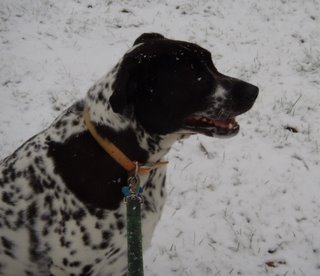
He loves it.
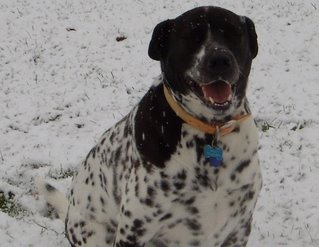
The snow is the only good thing about this morning, which started badly when I stumbled getting out of bed. This has to be a new standard of clumsiness even for me, and set the tone for a morning of minor aggravations.
Aggravation #1: People who misspell my name despite having received items from me that spell my name correctly. It's "Clair," without the e. Yes, it's not the usual spelling. If you consistently misspell it, you are not paying attention and you are being disrespectful, and therefore I feel no obligation to pay attention to you. If you can never remember how I spell it, call me "Ellen" instead. It's one of the reasons I use both names.
Aggravation #2: Anonymous blog commenters. I don't expect you to register for Blogger just so you can comment on my blog. If you're not a member of Blogger, however, I do expect you to sign your posts. I've had a couple of snarky comments lately from total strangers who haven't signed their posts, and from now on, I'm deleting all anonymous comments. My name's on this thing, and if you want to post, yours should be too.
Aggravation #3: The Gardiner town fathers have taken all the trashcans out of the Common, presumably because they fill with snow and are too hard to maintain in the winter. This is not a good solution. I'd contribute to a collection for trashcans with hoods. People don't stop going to the Common in the wintertime, and who wants to pick up a winter's worth of trash once the snow melts?
I think I need to go outside and throw a few snowballs at trees. Feel free to list your own potential snowball targets in the comments section -- as long as you sign your posts...

He loves it.

The snow is the only good thing about this morning, which started badly when I stumbled getting out of bed. This has to be a new standard of clumsiness even for me, and set the tone for a morning of minor aggravations.
Aggravation #1: People who misspell my name despite having received items from me that spell my name correctly. It's "Clair," without the e. Yes, it's not the usual spelling. If you consistently misspell it, you are not paying attention and you are being disrespectful, and therefore I feel no obligation to pay attention to you. If you can never remember how I spell it, call me "Ellen" instead. It's one of the reasons I use both names.
Aggravation #2: Anonymous blog commenters. I don't expect you to register for Blogger just so you can comment on my blog. If you're not a member of Blogger, however, I do expect you to sign your posts. I've had a couple of snarky comments lately from total strangers who haven't signed their posts, and from now on, I'm deleting all anonymous comments. My name's on this thing, and if you want to post, yours should be too.
Aggravation #3: The Gardiner town fathers have taken all the trashcans out of the Common, presumably because they fill with snow and are too hard to maintain in the winter. This is not a good solution. I'd contribute to a collection for trashcans with hoods. People don't stop going to the Common in the wintertime, and who wants to pick up a winter's worth of trash once the snow melts?
I think I need to go outside and throw a few snowballs at trees. Feel free to list your own potential snowball targets in the comments section -- as long as you sign your posts...
Sunday, December 03, 2006
Picture of the week

Since I don't post on Sundays, it'll be picture day. This is the Cobbosseecontee behind the abandoned Gardiner Paperboard factory, more or less across the street from my apartment building.
Saturday, December 02, 2006
What's Blu-ray?
Who's asking: Mike Clements, W. Gardiner, ME
This question came up at the movies last night, when a preview trailer advertised the availability of Talladega Nights on DVD, PSP and Blu-Ray. (We saw Tenacious D in: The Pick of Destiny. To my kids and godchildren I say: this movie is not appropriate for you. If you do see it -- which I'm telling you not to -- do not think for one minute that I understood half the jokes or thought any of it was funny. Go see Happy Feet instead. Thank you.)
Neither Mike nor I had ever heard of it, but apparently Blu-ray is the next big thing in home video technology. Blu-ray discs (BD) are written to be read by blue-violet lasers, instead of the red lasers used to read standard DVDs and CDs. The blue-violet light has a shorter wavelength, which allows data to be packed more tightly on a Blu-ray disc than on a DVD. Therefore, Blu-ray is the emerging technology for high-definition videos. Blu-ray discs can hold more than five times as much data as a DVD -- up to 25GB of data on a single layer disc, and up to 50GB of data on a double-layer disc. Blu-ray discs are not the same as high-definition DVDs (HD-DVDs), which use a different technology.
Blu-ray drives are not yet available for PCs, but that's planned for the future. The electronic companies are manufacturing Blu-ray machines that can also play DVDs and CDs, so if this technology takes off, you won't have to replace your existing library. Seven of the eight major movie studios are now releasing videos in Blu-ray format as well as in DVD.
I'm not rushing out to buy one, though. For those who are considering it, I have one word: MiniDisc.
Friday, December 01, 2006
Who are the poorest people in the world?
Who's asking: Sue Schulz, Herrsching, Germany
Sue asked me this question a while back, so Sue, I'm sorry for taking a while to get to it.
Past a given point, poverty's academic: you either have enough to eat, or you don't. You have a roof over your head, or you don't. You have confidence that you'll continue to eat and to sleep indoors, or you don't.
Millions of people don't get enough to eat every day, and have no permanent place to live. Most of these people live south of the Equator; a disproportionate number of them live in Africa.
The nation with the world's lowest GDP, however, is in not in Africa, but between the South China Sea and the Indian Ocean. East Timor (pop. 947,000) comprises all or part of four islands in the Indonesian archipelago, and has a per-capita gross domestic product of only $400/year. Its colonial history makes East Timor the only Portuguese-speaking country in Asia; it was a Portuguese colony until 1975, then fought Indonesia for independence until 2002. As part of its efforts to put down the insurgency, the Indonesian government destroyed farmlands, blocked the distribution of food, and obstructed basic medical care.
Riots over internal military issues split the country again earlier this year, and a U.N. peacekeeping force led by Australia currently occupies the country.
Economic development, investment and growth are the only longterm cures for global poverty. If you want to buy goods produced in lesser-developed countries at prices that are fair to the makers, check out the Global Exchange gift shop.
This week I read three massive manuscripts for clients who pay me for discretion, as well as for any expertise I may have. I only finished one published book, which had sat on my to-be-read pile for much too long.
What I Read This Week
Judy Clemens, To Thine Own Self Be True. Dairy farmer and motorcycle aficionado Stella Crown is having a tattoo done when the tattoo artist disappears, and his wife is murdered. People who won't talk to the police don't mind talking to Stella, but Stella -- unlike some amateur sleuths -- keeps the cops in the loop from beginning to end. With her third book, Judy Clemens seems to be pulling off the impossible: a realistic, engaging amateur detective series that is not inappropriately light-hearted, and does not minimize the effects of violence on its victims. Well done.
Subscribe to:
Posts (Atom)